How long do dental implants last is the question every dental traveller asks before boarding the plane home — usually more than the price itself. You can find the cheapest quote in Europe, but a quote means nothing if the implant fails at year three and you have to fly back again. This article answers that question with numbers, not marketing: we analysed more than 1,000 implant cases treated at the Clínica Dentária Santa Catarina in Porto since 1968, and we compared our records against the strongest published survival data on how long dental implants last.
Before going deeper, know that the honest short answer is 20 years or more for the titanium implant itself, in most patients, when the case is planned properly from the start. The dental implant cost in Portugal is only one part of the decision; the longevity of the work is the part that actually protects your money over two decades. In this guide you will find our real follow-up figures, the scientific data on 10-year and 20-year survival, the factors that shorten implant life, and the maintenance that keeps an implant alive for life.
How Long Dental Implants Last: The Data Behind the Answer
Every clinic can claim its implants last a long time. Few can show you the records. At the Clínica Dentária Santa Catarina, founded in 1968 on Rua Santa Catarina in Porto, we have followed our implant patients systematically for decades. When we pulled the files for this analysis, we reviewed more than 1,000 implant cases covering single crowns, bridges and full-arch rehabilitations, with follow-up periods running from 5 to more than 20 years.
The headline result is straightforward: across these 1,000+ cases, more than 96% of the implants were still in place and functioning at the 10-year mark. Patients who lost an implant almost always lost it within the first two years, which tells you a lot about how long dental implants last in practice: the first two years are the window that separates a reliable treatment from a failed one.
What our patient registry actually tracks
Our follow-up file is not a brochure. It records the date of placement, the implant system and size, the bone density and any grafting, the type of prosthesis, the patient’s health profile, and every check-up after that. This is why we can speak with confidence about how long dental implants last in real patients, rather than quoting a theoretical average published in a marketing slide.
Why the first two years decide everything
Almost every implant we have ever recorded as lost disappeared in the first 24 months, most often in the first six. That early phase is when osseointegration either succeeds or fails, before the bone has fully locked onto the titanium surface. After that wall is crossed, the gap essentially closes: late failures do exist, through peri-implantitis or overload, but they are rare. This is why the answer to how long dental implants last is so dependent on the quality of the first year.
10-Year and 20-Year Survival Rates: What the Science Actually Shows
Our own numbers line up with the international literature, which is exactly what a clinic should be able to say. A landmark systematic review published in the International Journal of Oral and Maxillofacial Surgery evaluated 23 longitudinal studies with a follow-up of at least 10 years, covering 7,711 implants, and reported a cumulative survival rate of 94.6% with a mean follow-up of 13.4 years. You can consult the systematic review of dental implant survival beyond 10 years directly on PubMed.
A more recent sensitivity meta-analysis published in the Journal of Dentistry estimated 10-year implant survival at 96.4% across 18 prospective studies using contemporary, roughened-surface implant systems; its full results are available in this 10-year dental implant survival meta-analysis. The evidence base is consistent: for a well-planned implant with a modern surface, the chance that it is still there ten years later sits between 94% and 97%.
What the numbers reach at 20 years
Published data for the 20-year mark are sparser but still reassuring. A 2021 cohort study followed 10,871 implants in 4,247 patients for up to 22 years, the kind of large, real-world registry we value in the clinic; it reported cumulative survival of 96.8% at 10 years and 94.0% at 15 years. Our own long-term patients confirm the same pattern: an implant that survives its first two years quietly remains a fixture of the mouth for decades. When a patient asks how long dental implants last, this is precisely the data we show them in the consultation room.
How our 1,000+ Portuguese cases compare
Our registry does not cherry-pick. It includes the same mix a busy Porto practice sees: smokers convinced to pause, diabetics controlled on medication, patients over seventy with reduced bone, and full-arch cases where the titanium bar carries most of the load. When our figures sit in the same band as the 7,711-implant and 10,871-implant studies above, it confirms that the longevity of properly placed implants is a reproducible, documented outcome, not a local exception.
What Shortens How Long Dental Implants Last in Real Patients
If survival rates sit above 94%, the right question is not « do implants fail? », but « what makes the remaining cases fail? ». In our 1,000+ cases, the failures clustered around a small number of controllable factors. Understanding them is the difference between a cheap treatment abroad and a trustworthy one.
Smoking
Smoking is the single most reliable predictor of early implant loss. Nicotine constricts the blood vessels that feed the healing bone, and healing is everything in the first months. In our experience, smokers who refuse to pause their habit before surgery have a measurably higher risk of losing the implant in year one. We are honest about this during the consultation, because honesty protects how long dental implants last for the individual patient.
Diabetes and general health
Poorly controlled diabetes slows osseointegration, the biological process by which the bone locks onto the titanium surface. Well-controlled diabetes is a different story: with HbA1c values in a healthy range, we place implants without hesitation. The same logic applies to osteoporosis and immune conditions. These are managed, not automatic exclusions, and managing them correctly is part of what determines how long dental implants last.
Bone volume and grafting
An implant needs bone, both in height and in width. When the ridge has collapsed after years of missing teeth, we rebuild it before placing the implant. Skipping this step to save money is the classic recipe for early failure. Our clinic performs bone grafting at our Porto clinic routinely and safely, and patients who need it price it into the plan from day one so that the follow-up stays clear.
Why Some Implant Work Lasts Decades: Components and Brand
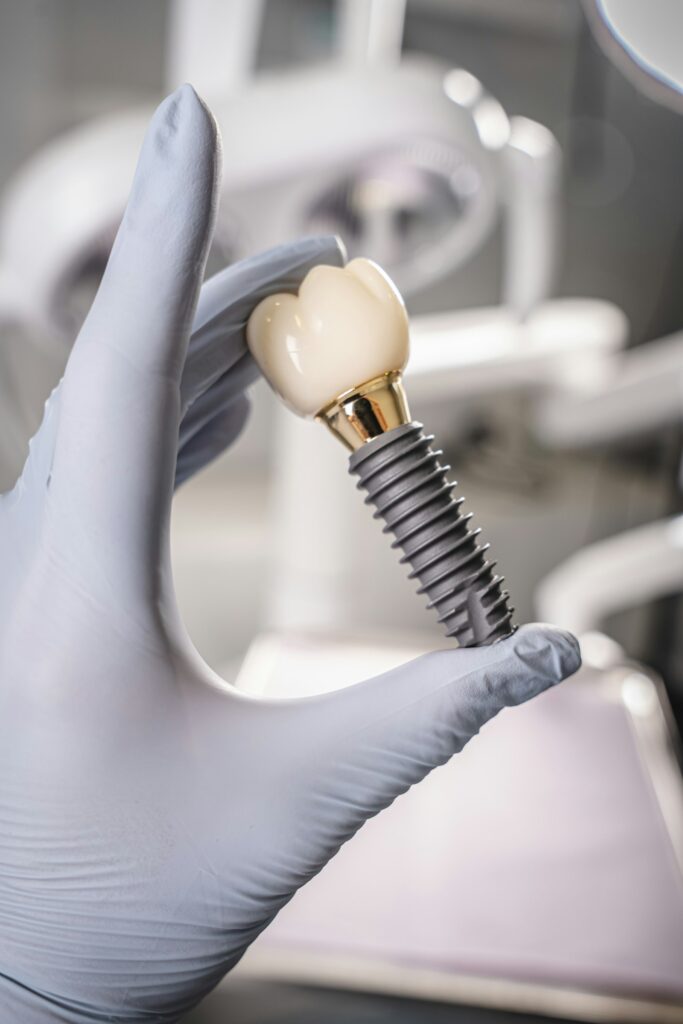
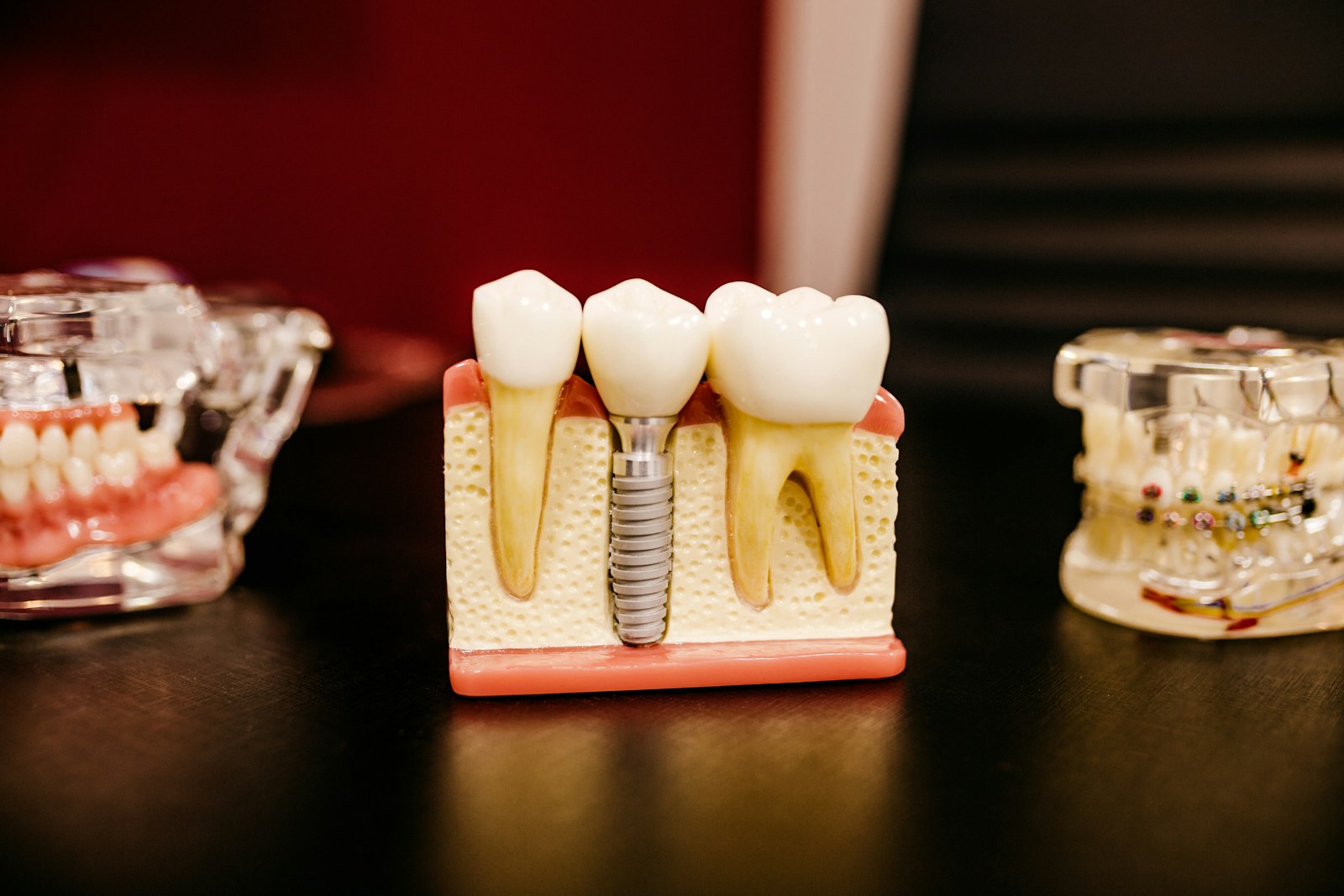
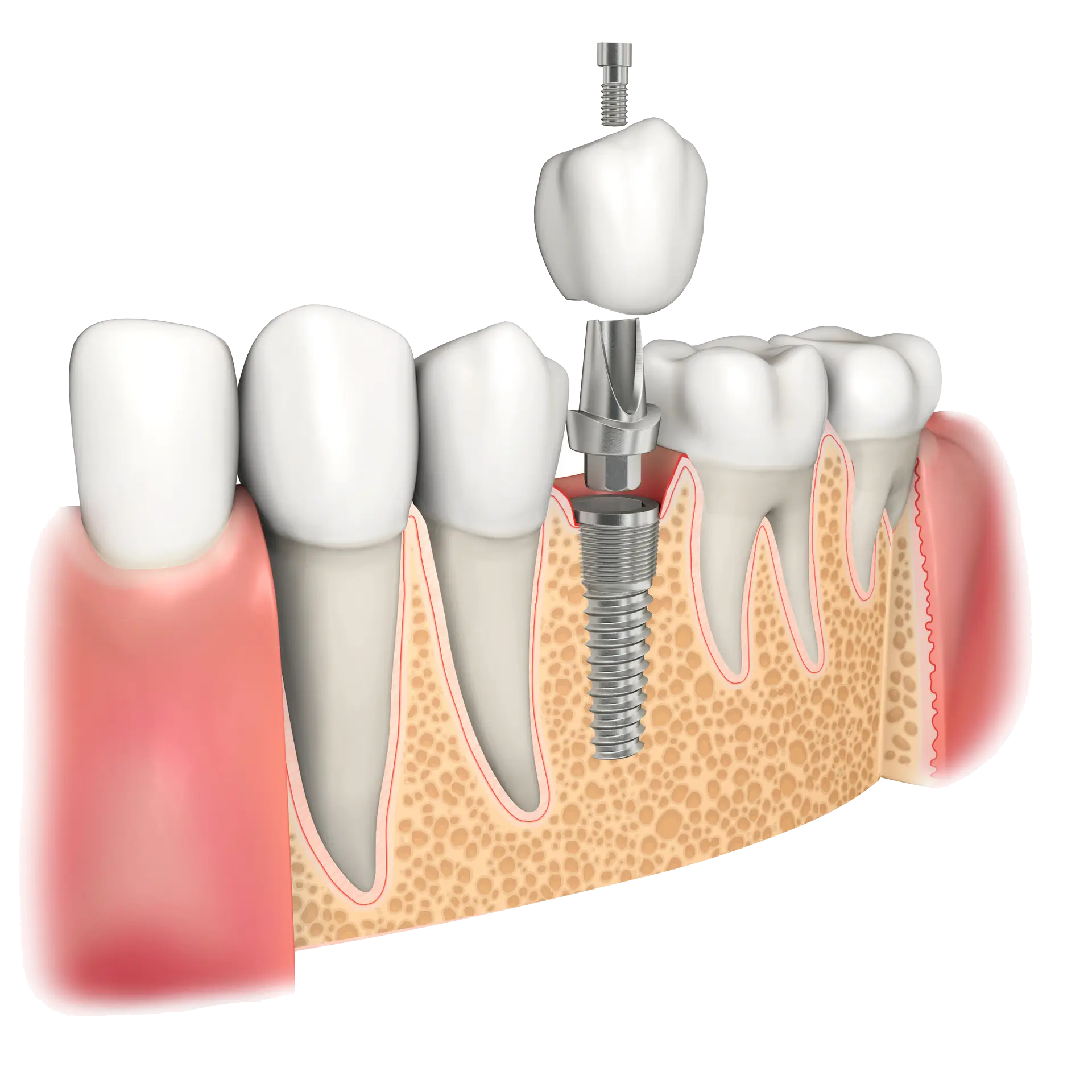
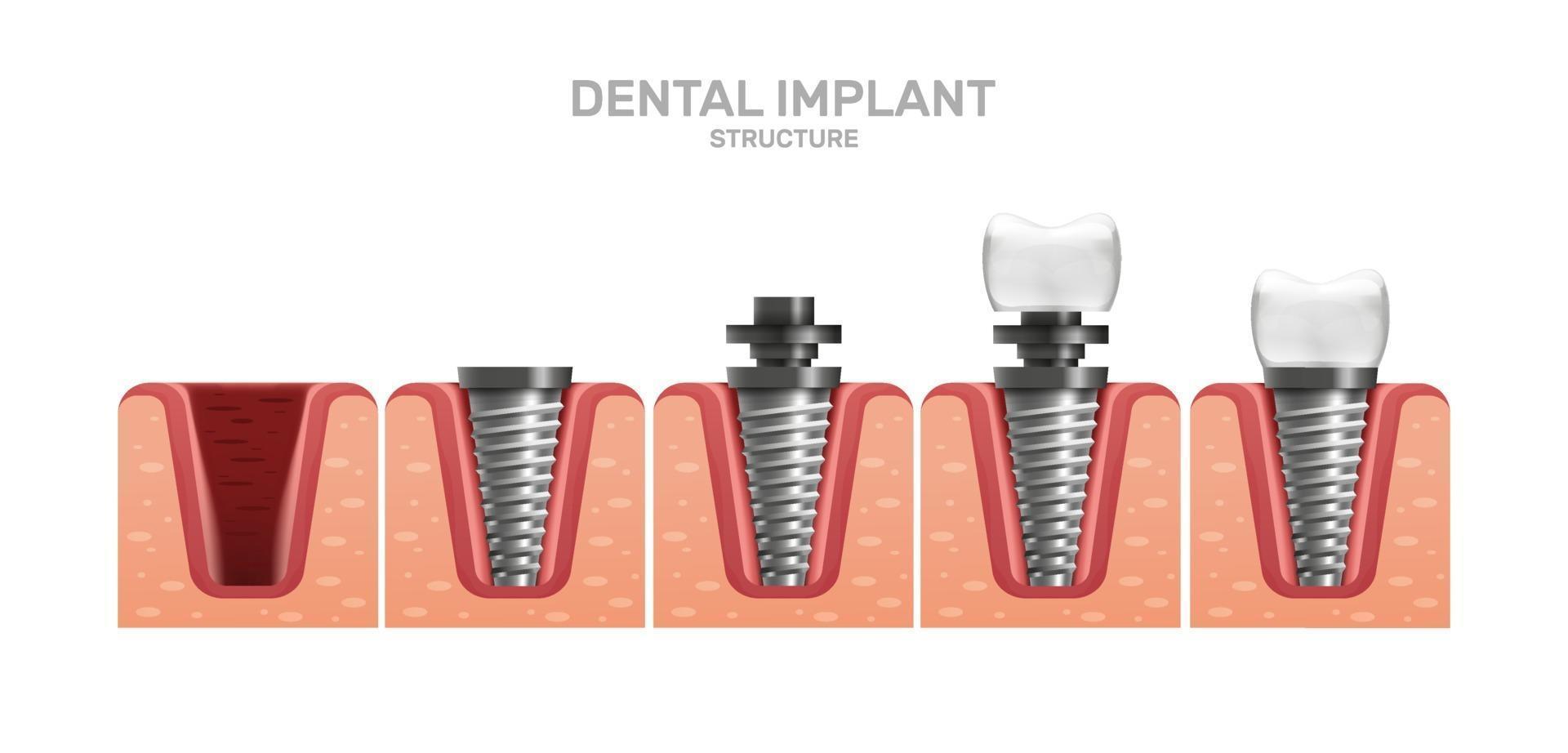
Most patients confuse the implant with the crown. They are not the same thing, and they do not wear out at the same speed. Understanding the difference is essential to a realistic answer on how long dental implants last:
| Component | Typical lifespan | What affects it most |
|---|---|---|
| Titanium implant (the screw) | 20 years to lifetime | Bone quality, hygiene, smoking |
| Abutment (the connector) | 10–20 years | Screw tightening, bruxism |
| Crown or bridge on the implant | 10–15 years | Grinding, material, maintenance |
| Full-arch prosthesis (All-on-4/6) | 15–20 years before replacement | Design, titanium bar, hygiene |
The implant is the durable part, the crown is the serviceable part
This is why the way our clinic guarantees the work matters. When a crown fractures after a decade of chewing, the titanium screw underneath is usually still perfect, and we simply replace the crown. Professionals who understand how long dental implants last separate the lifetime of the screw from the lifetime of the prosthetic teeth, and they plan the budget accordingly, which is exactly the reassurance dental tourists are looking for.
Why the brand matters: Straumann and ISO/TC 106 certification
Not every implant is manufactured to the same standard, and the difference shows up over decades, not over months. We place Straumann implants exclusively: a Swiss system certified CE, produced under strict ISO standards, and documented by clinical evidence published over more than 40 years. Straumann implants carry a lifetime manufacturer warranty, which is a written commitment to how long dental implants last rather than a promise whispered at the end of a consultation. Our clinic also holds ISO/TC 106 certification, the international standard for dental materials and products; it is a formal, audited commitment that visitors can verify, and it matters precisely because longevity is built in the preparation, the sterile protocol and the choice of components, not in the brochure.
Your Role in How Long Dental Implants Last: Maintenance After Return
The clinic can deliver a flawless implant, and its long-term survival still partly depends on you. Our distant patients follow the same maintenance rules as our Porto residents, and the results show it. Two habits protect the investment more than any other.
Daily hygiene around the implant
A healed implant is not a natural tooth: it has no ligament, so plaque behaves differently around it. Interdental brushes, patient-specific brushes and regular flossing keep the gum sealed around the titanium. Neglected hygiene leads to peri-implantitis, the main biological cause of late implant loss, and the entire reason some patients still lose implants after a decade. The same rules apply to full-arch work: the titanium bar of an All-on-4 restoration in Portugal needs specific under-bar cleaning that we demonstrate before you leave the clinic.
Yearly professional check-ups
An implant that smoulders quietly in the gums often shows no symptom until it is late. A yearly clinical and radiological check, which we can organise remotely and combine with your annual trip, catches bone changes while they are still reversible. Our dental treatment abroad guide explains exactly how to plan these return visits around your travel schedule, including follow-up by WhatsApp between visits.
FAQ: How Long Do Dental Implants Last?
Can a dental implant last a lifetime?
In functional terms, yes for most patients: once past the first two years, titanium implants routinely remain in place for 20, 30 or more years. The lifetime warranty on Straumann implants is a formal expression of that reality, not a marketing slogan.
How long do dental implants last compared to natural teeth?
With the hygiene described above, implant-supported teeth can outlive the teeth they replaced, which had already been lost. The comparison is favourable to implants precisely because a healthy implant never decays, and our oldest patients prove it.
How long do dental implants last if you smoke?
Smoking measurably increases early failure risk. The honest answer is that a smoker who does not pause has a materially shorter expected survival than a non-smoker. We recommend stopping before surgery and during healing to protect how long dental implants last.
What is the failure rate of dental implants in the first year?
In our registry and in the literature, early failures sit in the low single digits, typically between 1% and 5% depending on the risk profile. Almost all failures occur within the first one to two years, which is why follow-up in that window is non-negotiable.
Are some implant brands more durable than others?
Yes. Premium systems like Straumann, with toughened surfaces and massive clinical documentation, consistently report the highest long-term survival rates in the studies we rely on, such as the 10,871-implant cohort followed for up to 22 years.
Conclusion: The Honest Numbers on Implant Longevity in Porto
How long dental implants last is no longer a mystery. The published evidence shows 94% to 97% of implants surviving ten years in the biggest international cohorts; our own registry of more than 1,000 Portuguese cases sits at the same level, and the systematic reviews of 7,711 and 10,871 implants confirm that such results are reproducible in routine practice.
What the same data means for your treatment choice
What separates a satisfied patient from a disappointed one is not luck: it is the combination of bone assessment, implant brand, surgical protocol, and your maintenance at home. At the Clínica Dentária Santa Catarina in Porto, you get the Straumann system, ISO/TC 106 certification, a permanent coordinator in your language, and a lifetime warranty on how long dental implants last.
Request your free quote within 24 hours on WhatsApp at +33 7 44 03 40 82. Our francophone and English-speaking coordinators will assess your case with a real number attached to it, send you a transparent price, and explain the realistic lifespan you can expect for your specific mouth.