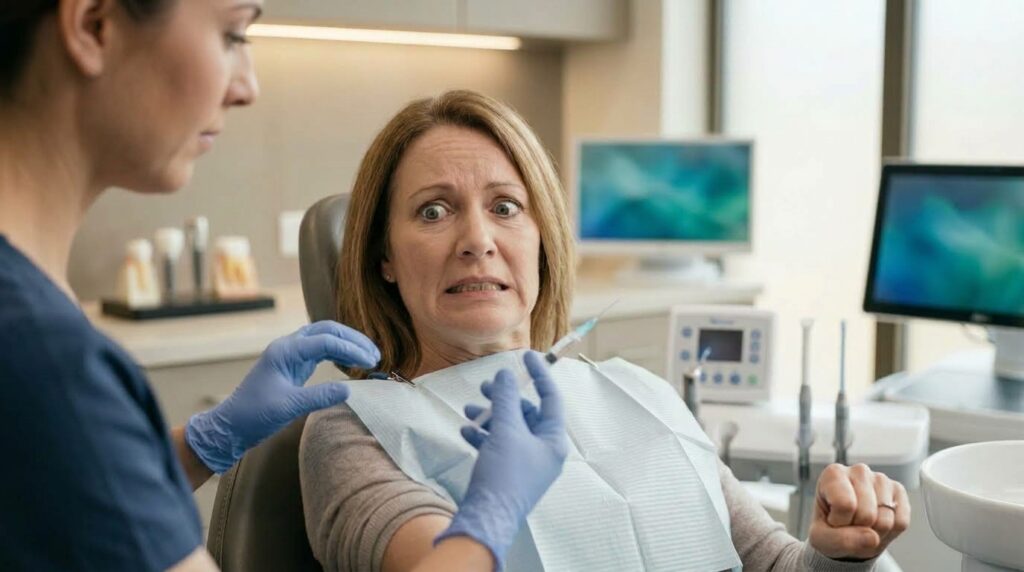
You are not alone, and you can be treated without suffering
If a dental drill makes your heart race, you are not alone. Across Europe 36–48% of adults report moderate dental anxiety and 12–15% have severe dental fear that makes them avoid care for years.
Many patients postpone implants for fear, not cost. At Clínica Dentária Santa Catarina in Porto we meet this weekly. Modern sedation dentistry dental implants lets you have surgery deeply calm, with little or no memory of it. To see how comfort is built in, read our guide to painless dental implants in Porto — it pairs with dental fear implants sedation.
1. Understanding Dental Fear and Implants: Why Anxiety Keeps Patients Away
Dental fear is not “nerves.” It is a documented psychophysiological response that combines learned experience, sensory triggers and catastrophic thinking.
A 2024 systematic review and meta-analysis of randomised controlled trials (Steenen et al., Journal of Anxiety Disorders) found that dental anxiety is highly prevalent in adults and constitutes a significant barrier to care, with severe phobia driving avoidance of treatment for years.
At Santa Catarina we screen every patient with the 5-question Modified Dental Anxiety Scale (MDAS) in 60 seconds. It tells us whether you need light anxiolysis, conscious sedation, or deeper support — so dental fear implants sedation is never one-size-fits-all.
1.1 How Dental Fear Impacts Oral Health and Implant Decisions
Delay has a bone cost: 0.5–1.0 mm width loss in 6 months, 40–60% volume in 3 years. What could be a 550 € single implant can become grafting. Fear also deepens with waiting — 68% of our anxious patients regret years lost, not teeth. Tailored dental fear implants sedation decouples care from fear. See our dental implants in Portugal overview.
1.2 The Psychology Behind Dental Fear and Implants Avoidance
Fear clusters around four triggers — loss of control, sensory cues (sounds, smells, vibration), catastrophic thoughts (“what if I feel pain?”), and prior trauma. A 2024 British Dental Journal study showed high-fear patients have elevated cortisol already in the waiting room, before treatment starts.
Fear and phobia differ. Fear is strong apprehension you can still reason with; phobia is avoidance that persists despite knowing you need care.
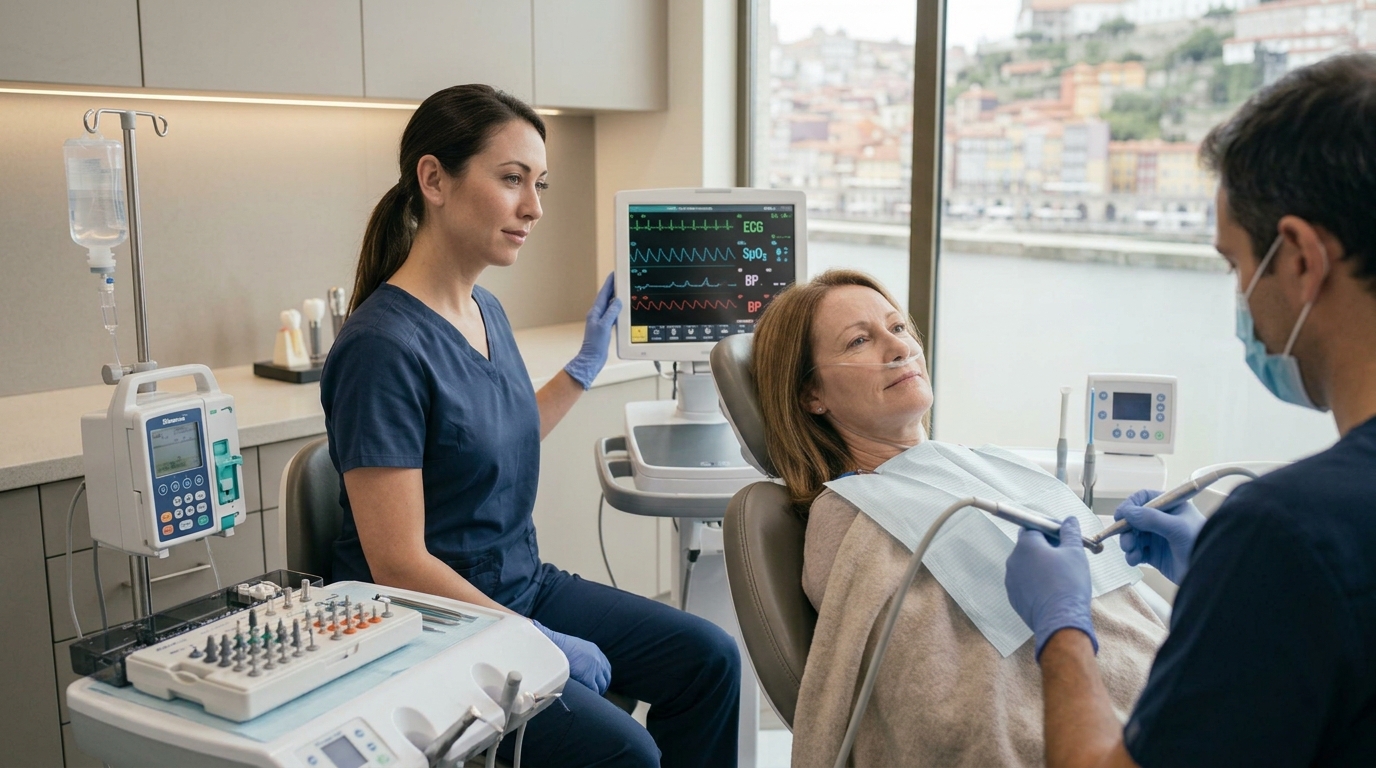
Modern monitoring makes sedation dentistry for implants predictable and safe.
2. Sedation Dentistry for Dental Implants: The Science Behind Pain-Free Surgery
Modern implantology is already less painful than imagined, but dental fear implants sedation makes it feel safer.
Implants are placed through a 3–4 mm gum opening, often flapless with guided surgery (92% of our All-on-4/6 cases). Bone itself has few pain receptors; local anaesthetic alone blocks sharp pain.
A 2026 systematic review published in Frontiers in Dental Medicine (15 RCTs, 1,238 implant patients) confirmed that both pharmacological and non-pharmacological interventions significantly reduce dental anxiety during implant surgery, with conscious sedation — particularly dexmedetomidine-based protocols — showing the strongest anxiolytic effect for moderate-to-severe fear, and high patient satisfaction reported across studies. One-year implant survival was identical with or without sedation (97.8% vs 97.5%), confirming sedation does not compromise outcome when protocols are respected.
2.1 What Sedation Dentistry Offers for Implant Surgery
Sedation dentistry dental implants combines two layers: local anaesthesia (stops pain signals) and anxiolysis/sedation (calms the mind and reduces awareness). Local alone is enough for ~60% of non-anxious patients — they feel pressure, not pain.
At Santa Catarina you remain responsive to verbal cues under conscious sedation — you breathe on your own, swallow and signal, but feel detached and comfortable. This is the sweet spot for most dental fear implants sedation cases.
2.2 Is Sedation Safe for Dental Implants?
Safety data is reassuring when monitoring is proper. The UK NHS (updated 2024) and the ADA 2025 anaesthesia guidelines report serious adverse events <1 in 10,000 for conscious dental sedation with trained staff and continuous monitoring.
Every dental fear implants sedation case in Porto includes pulse oximetry, capnography for IV cases, non-invasive blood pressure every 5 minutes, 3-lead ECG and supplemental oxygen. An anaesthetist or sedation-certified dentist stays chairside from induction to full recovery. Doses are titrated upward from low until you reach your target calm; reversal agents (flumazenil) are immediately available though needed in <0.3% of our 2023–2025 audit (n=412 sedated implant surgeries, zero hospital transfers). Lower stress hormones under sedation often mean 15–20% less swelling at 48 hours. The evidence and monitoring standards are summarised in the Frontiers systematic review on anxiety control in implant surgery and the ADA guidance on anesthesia and sedation.
3. Conscious Sedation Options for Anxious Patients Considering Implants
Not every anxious patient needs the same depth.
3.1 Oral Sedation and Nitrous Oxide: Light Options for Mild Anxiety
Oral sedation (single benzodiazepine 45–60 minutes before) keeps you awake and conversational but drowsy and less bothered by sounds and time.
Nitrous oxide (laughing gas) is inhaled via nasal mask, works in 2–3 minutes, gives calm euphoria and finger tingling, and clears in 5 minutes — you can often travel 30 minutes later (escort still advised).
Together these cover ~30% of anxious patients dental implants sedation cases where fear is present but not paralysing. For dental anxiety implants Porto patients with moderate anxiety, this combination is frequently the first suggestion before stepping up.
3.2 Conscious IV Sedation: The Gold Standard for Anxious Patients
For most who say “I need dental fear implants sedation to even consider implants,” conscious IV sedation is the most predictable technique. A thin cannula in the hand, then midazolam (often with low-dose fentanyl) titrated until you respond to “open a little wider, please” but feel warm, detached and indifferent.
Why it is the gold standard for anxious patients dental implants sedation: titratable minute-by-minute (unlike a single pill), deep amnesia in 78–85% (no new trauma encoded), rapid onset (45–90 seconds) with time distortion (~70% shorter perceived), and sufficient for long surgery (All-on-4 2.5–3 h, multiple implants, grafting) in one visit — fewer trips from France, Belgium or Switzerland.
Local anaesthetic is added after you are calm — you will not feel the injection properly. Throughout, SpO₂, end-tidal CO₂, ECG and BP are displayed and logged. Our Porto anaesthetists speak French or English, so reassurance is in your language.
4. IV Sedation vs General Anaesthesia for Dental Fear Implants Sedation
Should you just be “fully asleep”? For dental fear implants sedation the choice between IV conscious sedation and general anaesthesia (GA) is not about “stronger,” but about appropriateness.
4.1 Choosing the Right Level: When Is IV Sedation Enough?
IV sedation is enough when you can breathe safely on your own with light support, tolerate not being fully unconscious knowing you will remember little, and are ASA I or II (healthy or mild, well-controlled systemic disease). It delivers ~90% of GA’s comfort with faster recovery and lower cost.
It shines for dental fear implants sedation in single-to-multiple implants (1–6) with or without minor grafting, full-arch cases where you want soft food that evening, and patients with strong gag or white-coat hypertension (stress BP that normalises once calm).
4.2 General Anaesthesia: For Severe Dental Fear Implants Cases
GA means fully unconscious with an airway device (laryngeal mask), breathing supported, waking with no awareness. We reserve GA for severe dental fear implants sedation needs: MDAS ≥19 or panic attacks at the door, 6–8 implants plus extensive grafting/extractions in a 4–5 h single session, or severe gag/special needs where even speaking triggers retching.
In Porto GA is performed by a hospital-grade anaesthetist in our building with full monitoring and recovery room, but requires pre-anaesthetic assessment (ECG, bloods if >50, 6 h fasting), an escort staying 24 h, and 4–6 h before discharge (no driving 24 h). Cost 800–1 200 € per session; implant survival is unchanged but logistics and price make it second-line.
| Sedation Level | Awake? | Memory | Best For | Recovery | Monitoring | Added Cost |
|---|---|---|---|---|---|---|
| Oral sedation | Fully awake, drowsy | Partial — remember most | Mild–moderate fear; 1–2 implants, <60 min | 2–3 h (escort) | SpO₂ + BP | +80–120 € |
| Nitrous oxide alone | Awake, euphoric | Remember but care little | Needle phobia, gag, short | 30 min | SpO₂ | +70–100 € |
| Conscious IV sedation* | Drowsy, responds to voice | 78–85% amnesia | Moderate–severe fear; All-on-4/6, multiple | 60–90 min (escort mandatory) | ECG + capnography + SpO₂ + BP q5min + anaesthetist | 250–350 €/session |
| Nitrous + IV combined | Drowsy | Strong amnesia | Severe gag + needle fear; longer | 60–90 min | Full IV monitoring | 300–380 € |
| General anaesthesia | Unconscious | No recall | Phobia, very long, special needs | 4–6 h, no driving 24 h | Full anaesthesia suite + airway | 800–1 200 € |
* Local anaesthetic added after you are calm in every row — so you never feel the injection. Costs sedation only; implants separate (single from 550 €, All-on-4 from 5 000 €/jaw, All-on-6 from 6 350 €/jaw).
For the full continuum from conscious sedation to deep sedation and GA, see the ADA guidance on anesthesia and sedation.
5. Dental Anxiety Implants Porto: How Santa Catarina Manages Anxious Patients
Choosing a clinic for dental anxiety implants Porto is about whether the team cares for anxious people, not just anxious teeth. Founded in 1968 at Rua de Santa Catarina, we treat 35–45 sedated implant patients monthly; 71% travel from France, Belgium, Luxembourg, Switzerland or the UK/Canada.
5.1 The Santa Catarina Protocol for Anxious Patients Dental Implants Sedation
Our anxious patients dental implants sedation protocol starts 7–10 days before you fly:
- Remote screening. Send your panoramic X-ray via WhatsApp (+33 7 44 03 40 82), complete MDAS + 3-question sedation form (ASA, meds, fasting). In 24 h you receive a free itemised plan: recommended sedation level, why, cost and alternative. Also see our transparent dental implant costs in Portugal for the implant part.
- Premedication. For moderate anxiety we prescribe a low-dose benzodiazepine the night before and 1 h before surgery. Fasting: clear fluids until 2 h before IV sedation, no solids 6 h before — per NHS and ADA guidance.
- Calm room. Our floor at Centro Comercial La Vie is bright and quiet with a separate calm room. You meet the anaesthetist first. BP is taken twice — the second is often 15 mmHg lower once you feel unrushed. The IV is placed after nitrous has softened the edge, with a small-gauge cannula — most say “oh, that was it?”
- Sedation then local. Only after you signal “I feel floaty/calm” do we add local (articaine/lidocaine). Straumann guided surgery follows: 3D-printed guide, implant through guide, torque check, provisional bridge. The anaesthetist speaks French or English throughout.
- Gentle wake-up. You recover with family/coordinator, receive a printed sheet plus WhatsApp voice note, and photo follow-up at home.
5.2 What to Expect on Surgery Day in Porto
Typical dental fear implants sedation day (All-on-4, IV sedation):
- 08:30 — Arrive with escort, no makeup/nail polish (for oximetry). Recheck MDAS, ECG, consent.
- 09:00 — Nitrous 2 min → IV placed → midazolam titrated. You stop checking the clock.
- 09:15–11:30 — Surgery. No pain, little memory. Four Straumann implants (lifetime guarantee) and titanium-reinforced provisional bridge fixed.
- 11:45 — Water, apple compote, mirror — even sedated patients grin.
- 13:00 — Escort walks you 4 minutes to hotel near La Vie. Nap, soft foods that evening.
- Day 2 — Control panoramic, bite check, flight home approved if no extensive grafting.
- Day 7–10 — WhatsApp check, stitches dissolve, local dentist polishes bridge if preferred.
Even with IV sedation, dental anxiety implants Porto saves 60–70% vs private France/Belgium — single implant pathway ~900 € total vs 2 200–2 800 € in France — plus direct flights <2 h, airport driver and French-speaking coordinator included.
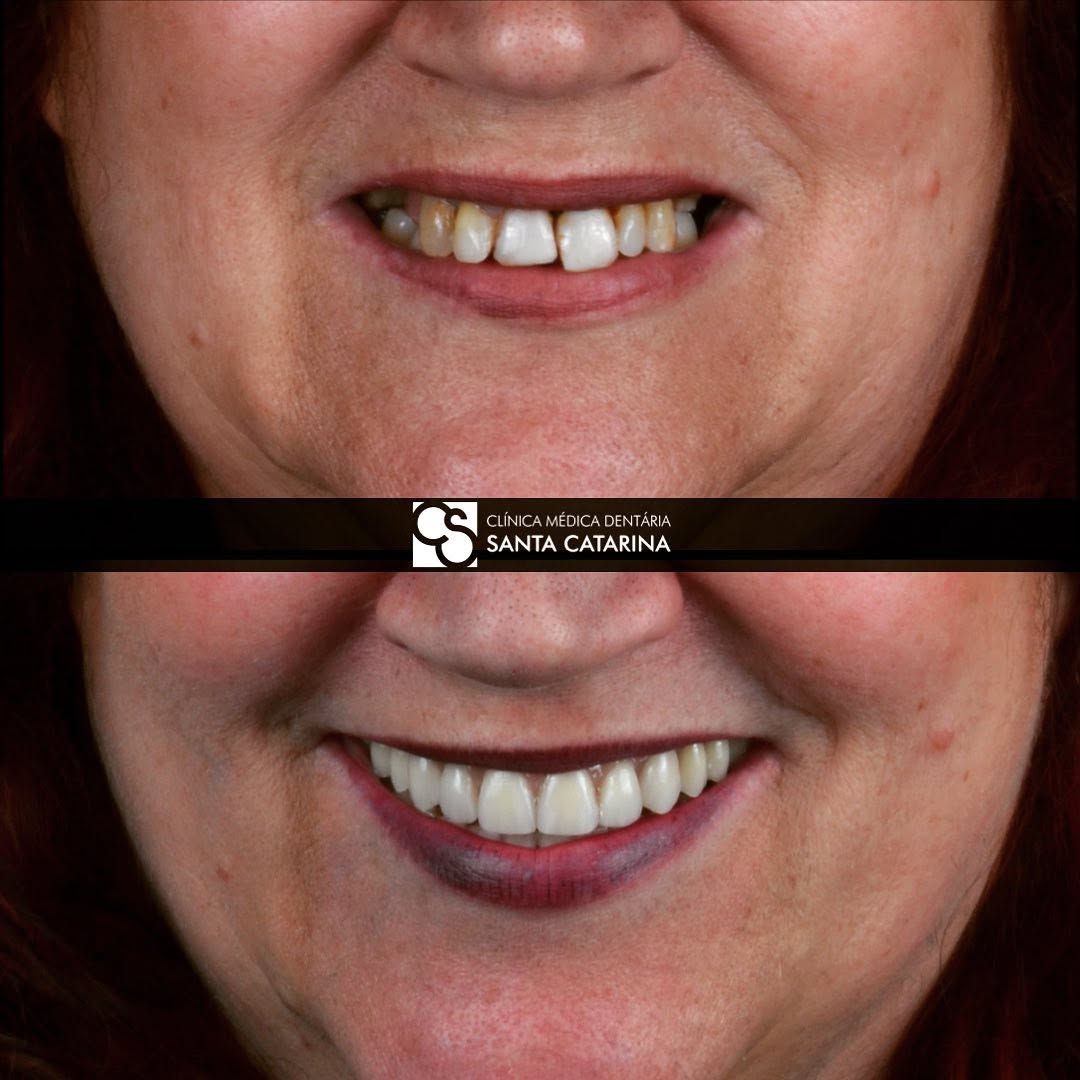
Porto recovery: soft foods, WhatsApp follow-up, and a smile that returns the same day.
6. Recovery, Safety and Costs: Your Complete Guide to Dental Fear Implants Sedation — FAQ
This section gives concrete numbers so dental fear implants sedation decisions are made with calm, not pressure.
6.1 How Much Does Sedation Add to Implant Costs?
Transparent 2026 costing at Santa Catarina (implant fees separate, sedation per session):
- Single Straumann implant + crown: 550 € (implant) + 500–600 € (zirconia crown) + sedation (see table). Example with IV sedation ~900 € total vs 2 200–2 800 € France private.
- All-on-4 jaw: from 5 000 € surgery-bridge provisional included; with IV sedation 5 300–5 350 €. UK private comparable 14 000–18 000 £.
- All-on-6 jaw: from 6 350 €; with IV sedation 6 650–6 700 €. Canada private CAD 24 000–30 000.
- Bone graft/sinus lift under sedation: +350–650 € per site, still inside one sedated session — avoiding a second trip.
Reimbursement: EU Directive 2011/24/EU itemised invoices accepted by French CPAM (S3125), Belgian INAMI, Swiss LAMal complementary and UK private insurance. Sedation is noted separately — some mutuelles reimburse part when prescribed for phobia (keep MDAS and prescription).
6.2 Frequently Asked Questions About Dental Fear Implants Sedation
Will you feel pain?
No. Local blocks pain; sedation blocks memory. Brief pressure for 2–3 seconds when torqued is common, but under IV sedation most say “I didn’t mind.”
How long groggy? Can I fly next day?
Oral/nitrous: clear 1–3 h. IV sedation: drowsy 3–6 h, clear by next morning — you can fly as passenger 24 h after IV sedation with approval.
What if I am too afraid even for the IV?
We start with nitrous + EMLA cream on the hand, then place the cannula while you breathe nitrous.
For what can go wrong and how we prevent it, see dental implant surgery complications and prevention.
7. Conclusion + CTA
Dental fear implants sedation is not a luxury — it is the reason many anxious patients finally get care. For those who have avoided the dentist for years, dental fear implants sedation turns an impossible appointment into a calm, managed experience — it is evidence-based care for the one in three adults whose fear keeps them from treatment.
At Clínica Dentária Santa Catarina in Porto, dental fear implants sedation is embedded in a hospitality protocol: French- and English-speaking coordinators, airport transfers, 3D-guided Straumann surgery, hospital-grade monitoring, and WhatsApp follow-up after you fly home. Since 1968 we have learned the best outcome is not just a titanium screw that integrates — it is a patient who says, “I finally feel safe at the dentist.”
If dental anxiety implants Porto has been the barrier between you and the smile you want, take the lowest-stress next step: send your panoramic X-ray for a free plan within 24 h. Tell us your MDAS score and which sedation options anxious patients interest you, and we will map — in plain language — exactly what your sedation dentistry dental implants pathway feels, costs and recovers like.
Get Your Free Sedation Plan in Porto Within 24 Hours
Your free quote in 24 hours via WhatsApp (+33 7 44 03 40 82) — come calm, leave smiling. With Clínica Dentária Santa Catarina, dentistry adapts to you, not the other way around.