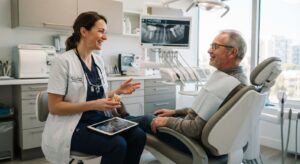
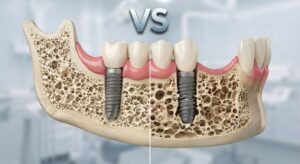
You have just placed dental implants in Porto, or you are about to. The surgery went smoothly, the temporary teeth feel great — and now comes the part nobody explains in detail: the year ahead. A complete recovery plan that covers the full twelve months is the difference between a smile that lasts a lifetime and one that develops silent problems.
Most guides stop after week one. But osseointegration — the process where your jawbone fuses with the titanium implant — takes months, and the way you care for your implants in the first year shapes their long-term survival rate, which reaches 97% or more with proper maintenance. This article walks you through every phase of the dental implant aftercare timeline: the first 24 hours, the first month, the osseointegration window, the final prosthesis fitting, and the maintenance habits that protect your investment for decades.
At the Clínica Dentária Santa Catarina in Porto, established in 1968 and certified ISO/TC 106, we have guided thousands of international patients through this exact journey. This dental implant aftercare guide reflects what we tell every patient before they fly home — in plain language, with precise timelines and the warning signs that actually matter.
Why a 12-month dental implant aftercare plan matters
An implant is not like a filling. It is a surgical device that must bond with living bone before it can function for decades. That bonding — osseointegration — does not happen overnight. The months following surgery are when your implant is most vulnerable, and also when the right dental implant aftercare habits become permanent.
What happens to your jawbone in the first year
In the first weeks, your body forms a blood clot around the implant, then gradually builds new bone cells that attach directly to the titanium surface. This is a biological process, not a mechanical one. The US Food and Drug Administration and dental societies both emphasise that full healing takes time and that patients play an active role in the outcome.
Three distinct phases define the first year: the healing phase (weeks 1-4), the osseointegration phase (months 2-6), and the maturation phase (months 6-12). Each requires slightly different dental implant aftercare, and this guide maps exactly what to do in each one.
The dental implant recovery timeline: month by month
Here is the complete dental implant recovery timeline, from the moment you leave the operating chair to your one-year anniversary. Keep this dental implant aftercare table as your reference point — it summarises the entire journey at a glance.
| Phase | Timeline | What is happening | Key priority |
|---|---|---|---|
| Immediate recovery | Day 0-3 | Swelling, mild pain, blood clot forming | Ice packs, soft food, no rinsing |
| Early healing | Week 1-4 | Tissue closes around the implant | Gentle hygiene, antiseptic rinse, avoid chewing on the site |
| Osseointegration | Month 2-6 | Bone fuses with the titanium implant | Normal routine, no smoking, regular check-ups |
| Prosthetic phase | Month 4-6 | Final crown or bridge is fitted | Bite check, comfort adjustments, hygiene around the crown |
| Maturation | Month 6-12 | Bone density reaches its peak | Annual check-up, professional cleaning, maintenance habits |
This dental implant aftercare timeline is the framework used by implantologists worldwide. Every patient is slightly different, but the milestones are remarkably consistent.
Months 1-3: the osseointegration phase
During months one to three, your jawbone is actively fusing with the implant surface. This is the most critical window for long-term success, and it is where your dental implant aftercare discipline pays off. Most patients return home after the first trip and resume a completely normal life — work, travel, social activities. The only restrictions are practical: avoid chewing directly on the implant site, keep smoking at zero, and maintain meticulous but gentle oral hygiene. For a full breakdown of how to handle discomfort in these early weeks, see our guide to managing pain after dental implants in Portugal.
Your dentist in Porto will schedule remote check-ins during this phase, usually by WhatsApp or video call, to confirm healing is on track. Some clinics fit a healing cap or temporary crown during this period to protect the site and maintain your smile. This structured supervision is a key element of dental implant aftercare at our clinic.
Months 4-6: the prosthetic phase
Between months four and six, osseointegration is typically complete. A follow-up X-ray or CBCT scan confirms the bone-implant connection, and the final crown, bridge or full-arch prosthesis is fabricated and fitted. This is the moment your permanent smile is delivered — and the point where a precise bite adjustment matters.
If your bite feels slightly uneven after the final prosthesis, tell your dentist immediately. A minor adjustment at this stage prevents long-term pressure problems on the implant. This is a normal part of the prosthetic phase, not a complication.
Months 7-12: full function and bone maturation
From month seven, your implants function like natural teeth. The bone continues to mature and strengthen throughout the year. The dental implant aftercare routine during this phase is identical to what a healthy patient does for natural teeth: brush twice a day, floss or use interdental brushes around the implants, and attend a professional cleaning and check-up.
The one-year mark is an important milestone. A thorough examination at twelve months establishes your baseline for decades of successful function — and it is the perfect moment to book your next annual visit.
A practical aftercare checklist: week 1 to month 12
A practical checklist is easier to follow than a set of abstract rules. Here is the dental implant aftercare checklist we give every patient at our Porto clinic, structured by time period.
Week 1: immediate post-operative care
- Apply ice packs to the cheek for 15 minutes on, 15 minutes off, for the first 48 hours to limit swelling.
- Take prescribed pain relief and antibiotics exactly as directed; do not skip doses.
- Do not rinse, spit or use a straw for the first 24 hours, to protect the blood clot.
- From day two, rinse gently with the prescribed antiseptic mouthwash.
- Eat only soft, lukewarm foods: soups, yoghurt, eggs, mashed vegetables, smoothies.
- Brush other teeth normally but avoid the surgical site with the brush.
- Sleep with your head elevated on an extra pillow for the first two nights.
Weeks 2-4: the early healing routine
- Transition from liquid to soft solid foods: pasta, fish, soft bread, cooked vegetables.
- Begin very gentle brushing around the implant with an ultra-soft brush.
- Continue the antiseptic rinse twice a day.
- Avoid alcohol, smoking and strenuous exercise.
- Attend your post-operative check-up at the clinic before flying home if scheduled.
Months 2-6: the osseointegration routine
- Resume your normal diet gradually, but avoid very hard foods directly on the implant.
- Introduce interdental brushes or water flossing around the implant site.
- Keep smoking at zero — it is the single biggest preventable cause of implant failure.
- Maintain regular check-ups as advised; report any unusual sensation.
Months 7-12: the maintenance routine
- Treat your implants exactly like natural teeth: twice-daily brushing and daily flossing.
- Book an annual professional cleaning and examination.
- Attend your 12-month review to establish your long-term baseline.
Oral hygiene during recovery
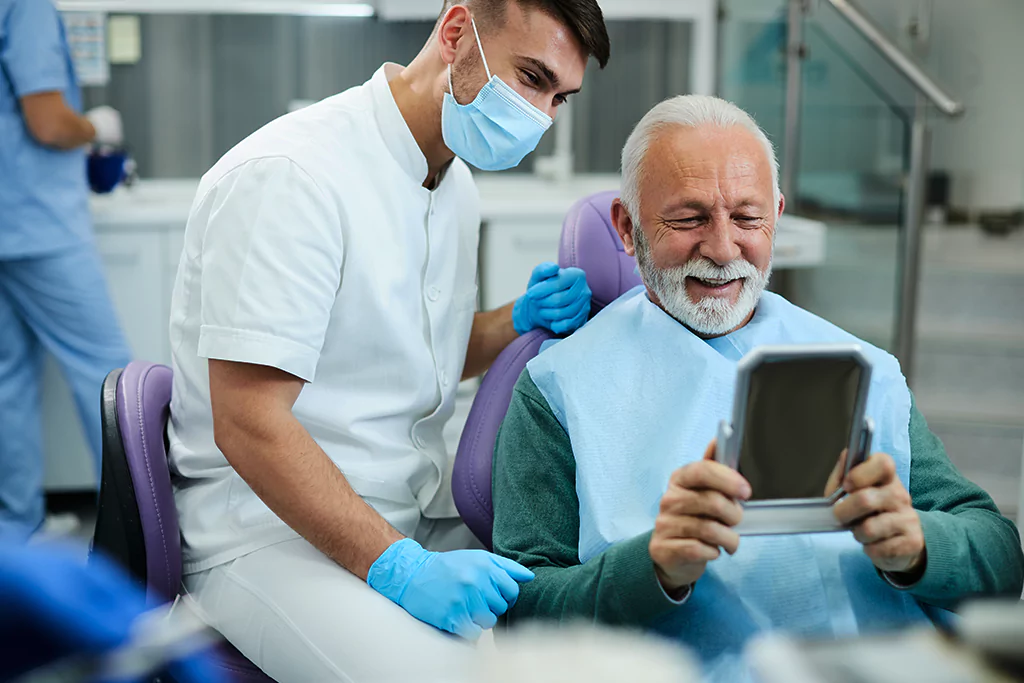
Oral hygiene is the foundation of successful dental implant aftercare. The implants themselves cannot decay, but the gum and bone around them absolutely can. Neglected hygiene leads to peri-implantitis — a silent inflammation that is the most common long-term cause of implant loss. The good news: it is almost entirely preventable with the right routine.
Cleaning techniques for effective dental implant aftercare
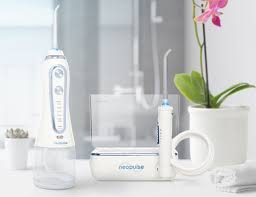
Use a soft-bristled or electric toothbrush and angle it towards the gum line around each implant. Interdental brushes are more effective than floss around implants for most patients because the implant neck is wider than a natural tooth. Water flossers are an excellent addition, particularly around implant-supported bridges and full-arch prostheses.
The teeth attached to an All-on-4 or All-on-6 prosthesis need special attention underneath. Your dentist will show you a specific cleaning technique, often using a specialised brush or water flosser tip. This is an essential part of aftercare for full-arch cases, and our team demonstrates it before you leave Porto. The same principles apply to the post-operative care after All-on-6 placement.
Foods to eat and avoid
During the first month, prioritise soft, nutrient-rich foods that support healing: proteins, vitamins C and D, calcium and zinc. Avoid crunchy, sticky or very hard foods directly on the implant site. After osseointegration, you can eat normally — a fully integrated implant supports chewing forces comparable to a natural tooth.
One habit matters above all others: smoking. Tobacco restricts blood flow to the healing bone and is the leading avoidable cause of osseointegration failure. Patients who stop smoking for the healing period dramatically improve their outcomes.
Warning signs: when to contact your clinic
Most patients heal without a single complication. But knowing which symptoms require immediate attention gives you confidence and protects your implant. Here are the dental implant aftercare warning signs that warrant contacting your clinic without delay.
Signs that require immediate attention
- Severe pain that worsens after day three instead of improving.
- Heavy bleeding that does not stop with pressure.
- Fever above 38°C, especially in the first week.
- Swelling that increases rather than decreases after 72 hours.
- Pus, an unusual taste or persistent bad breath around the implant.
- Mobility of the implant or the temporary prosthesis.
- Numbness that does not resolve.
Our clinic provides remote follow-up via WhatsApp after you return home, so you are never alone with a concern. A photo or a short video allows our team to assess most situations quickly and advise whether an in-person visit is needed. The World Health Organization likewise stresses the importance of professional follow-up and prevention in oral health — the same logic that guides our aftercare programme.
Above all, remember that dental implant aftercare is a year-long commitment, not a two-week task. The habits you build in the first twelve months protect your smile, your chewing function and your investment for decades to come.
Follow-up visits and long-term maintenance
Aftercare does not end when you fly home. Good dental implant aftercare is a long-term relationship with your oral health. The visits themselves are quick and painless — and they are what keeps your implant healthy for decades, alongside the daily hygiene routine described in this dental implant aftercare guide.
What your dentist checks at each visit
At every follow-up, your dentist assesses the gum health around each implant, checks for signs of inflammation, verifies the stability of the prosthesis, and takes a check-up X-ray when appropriate. A professional cleaning removes any tartar or plaque that home brushing cannot reach, completing your dental implant aftercare cycle.
If you are treated abroad, most patients combine this with their routine dentist at home, sending the treatment documentation provided by the Porto clinic. Our dental treatment abroad guide explains how to organise your follow-up care and your whole trip in practice.
For European patients, remember that your treatment may be partly reimbursable under Directive 2011/24/EU. Keep all invoices and treatment documentation from your Porto clinic — they are also useful for your annual maintenance visits at home. If you are still comparing prices before travelling, our guide to the dental implant cost in Portugal gives you the full picture.
FAQ: your dental implant aftercare questions
How long does full dental implant healing take?
Full healing takes 3 to 6 months for osseointegration, with continued bone maturation up to 12 months. The temporary and final prostheses are fitted according to the dental implant aftercare timeline described above. You can resume normal life immediately after the first week.
Can I fly home the day after implant surgery?
Yes, in most cases. Your dentist will confirm this before you leave. Patients typically stay one to three days in Porto for the first visit, then fly home. Remote follow-up is provided after your return, so travel is rarely a constraint.
What is the biggest cause of implant failure?
Smoking and neglected oral hygiene are the two leading preventable causes of implant failure. Both affect the gum and bone around the implant. Avoiding tobacco during the healing period and maintaining a consistent dental implant aftercare routine dramatically reduce the risk of peri-implantitis.
Do dental implants hurt during the recovery?
Most patients report only mild discomfort in the first two to three days, controlled with standard pain relief. The surgery itself is performed under local anaesthesia. Pain after placement is well understood and easily managed with the right guidance.
How often should I see a dentist after my implants are fitted?
Once a year for a professional cleaning and check-up, in addition to twice-daily hygiene at home. The 12-month review after placement is particularly important to establish your long-term baseline. More detailed recovery advice is also available in our guide to follow-up and care tips after dental treatment in Porto.
The twelve months after your implant placement are a partnership between you, your dentist and your own daily habits. Follow this dental implant aftercare timeline: protect the surgical site in week one, maintain gentle hygiene during osseointegration, attend your prosthetic phase fitting, and keep your annual maintenance visits. That is the complete formula for an implant that serves you for life.
At the Clínica Dentária Santa Catarina in Porto — certified ISO/TC 106 since 2010, using premium Straumann implants with a lifetime warranty — we support every patient through the full recovery, with a French- and English-speaking coordinator and WhatsApp follow-up after your return. Request your free quote in 24 hours via WhatsApp, and start your journey with a team that stays with you long after the surgery.