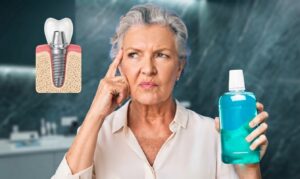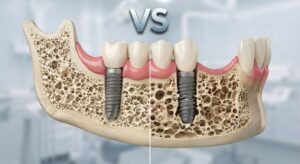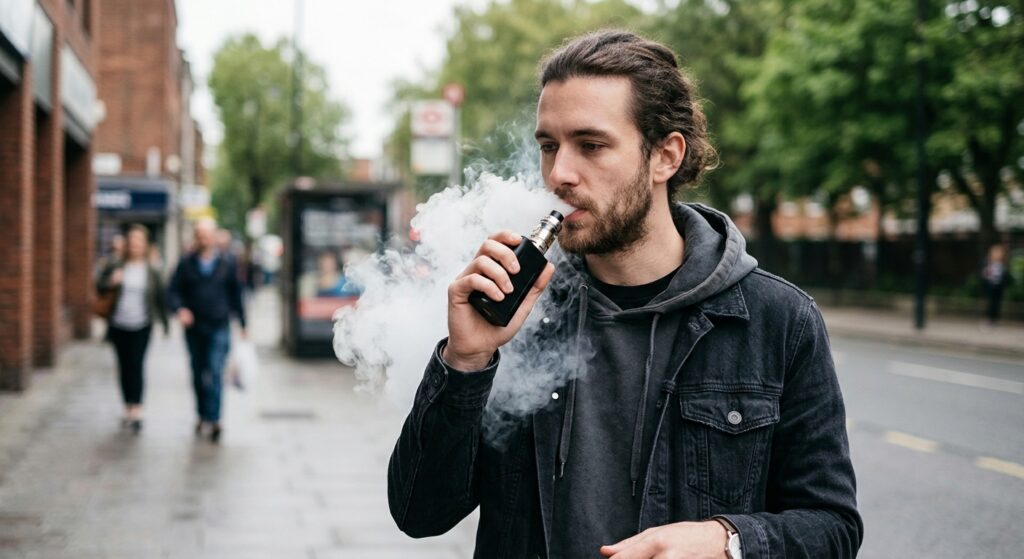
Considering dental implants but vape daily and wonder if vapour heals like smoking? You are not alone. Searches for vaping and dental implants have risen sharply as e-cigarettes replace cigarettes and patients ask whether vapour is safer for healing. The short answer: vaping is not harmless, yet its risk differs clearly from smoking.
At the Clínica Dentária Santa Catarina in Porto — ISO/TC 106 certified since 1968, using lifetime-guaranteed Straumann implants — we discuss this topic with international patients every week. An implant must be colonised by bone over 8 to 16 weeks (osseointegration). Anything that cuts blood flow, dries mucosa or fuels inflammation can delay that bond. See how we plan dental implant treatment in Portugal step by step, from 3D scan to final crown. This guide explains what 2024-2025 research says, answers does vaping affect dental implants, details vaping after dental implant surgery timelines, and compares vaping vs smoking dental implants with real numbers.
1. Vaping and Dental Implants: Why This Question Matters Before Surgery
Vaping and dental implants meet at the most sensitive moment: healing. An implant is not glued; bone must grow onto titanium. Blood delivers oxygen, immune cells and growth factors. Inhaled products that constrict vessels, reduce saliva or shift the microbiome can therefore delay integration, increase infection risk or cause early bone loss.
E-cigarettes heat a liquid — propylene glycol, vegetable glycerin, flavourings, usually nicotine — into an aerosol that is not harmless water vapour. The CDC on health effects of vaping notes that aerosol can contain nicotine, volatile organics, heavy metals and flavour chemicals such as diacetyl. Even nicotine-free liquids have shown low pH and cytotoxic potential in lab studies. The mouth is the entry point, so gums and the implant collar are exposed first.
What vaping actually delivers to your mouth
Three elements matter. First, nicotine: a vasoconstrictor that narrows small vessels, cutting oxygen delivery by up to 30% in the first hour. Less oxygen means slower fibroblast activity, weaker clot stability and delayed collagen formation around the implant.
Second, base liquids. Propylene glycol draws water from mucosa, causing dry mouth. Saliva buffers acids and defends against bacteria; a dry mouth raises caries risk and plaque at the collar, reported more often in vapers in a 2024 JADA clinical study.
Third, flavourings and heat. Heated flavours irritate epithelium, cause burning and damage epithelial cells in vitro. Implants do not decay, but the soft-tissue seal is sensitive to that irritation.
Who should be extra cautious about vaping and dental implants
Risk is not equal:
- Dual users (vape plus cigarettes) — highest plaque and inflammation in cohorts.
- Heavy nicotine (≥20 mg/ml) with frequent puffs — sustained vasoconstriction.
- Bone grafts, sinus lifts or All-on-4/All-on-6 — larger wound, longer integration.
- History of periodontitis or peri-implantitis — amplified inflammation.
- Poor hygiene or infrequent cleaning — plaque plus dry mouth accelerates bone loss.
If this is you, your vaping habits need a personalised plan.
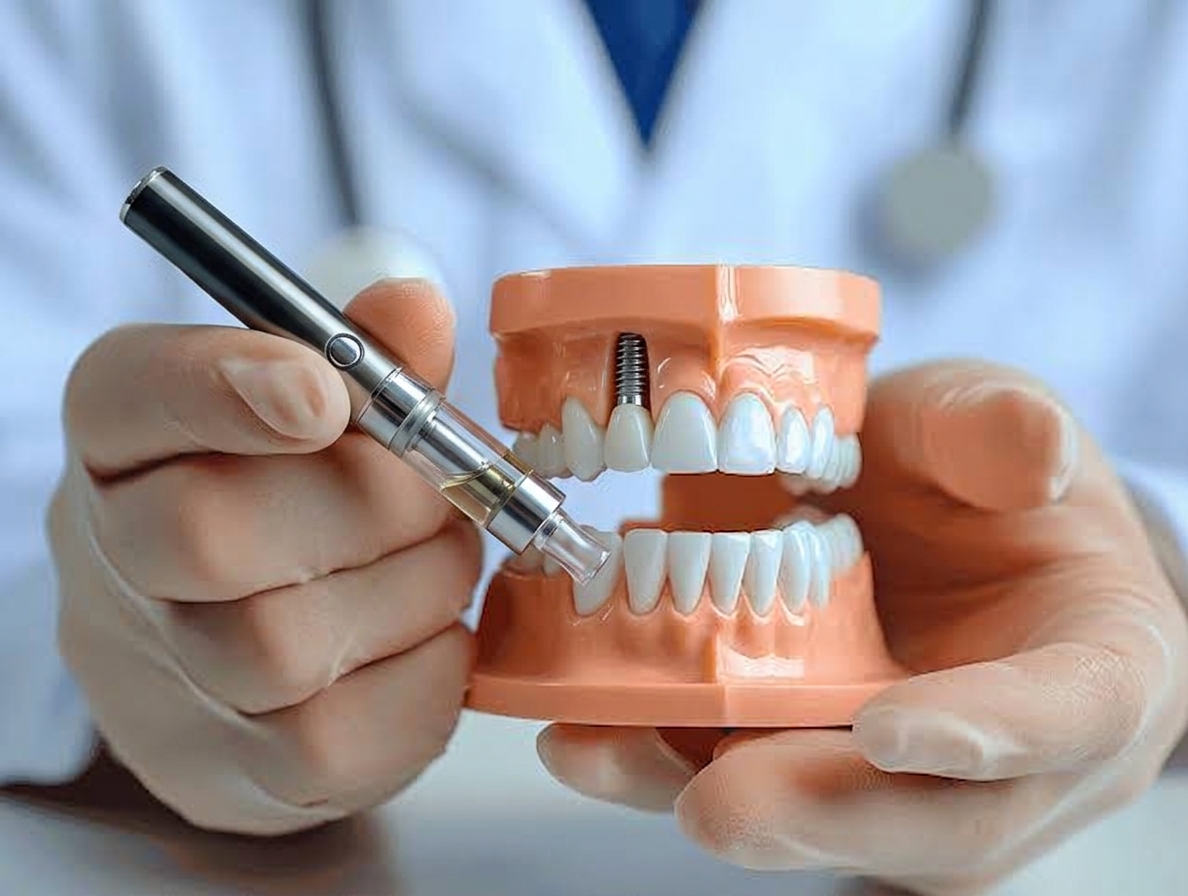
2. How Does Vaping Affect Dental Implants During Healing?
So does vaping affect dental implants while bone is bonding? Yes, 2024-2025 evidence shows a graded effect between non-smokers and cigarette smokers.
A 2025 systematic review and meta-analysis on electronic cigarettes and periodontal health (PMC12142770) analysing ten studies (2019-2024) found a clear gradient: non-smokers healthiest, vapers in the middle, cigarette smokers worst. Non-smokers had significantly lower plaque index (mean difference -20.63, p<0.001) and probing depth (MD -1.91mm, p=0.01) than vapers. Among periodontitis patients, smokers showed deeper probing than vapers. Vaping is less damaging than smoking but worse than no inhalation.
The same pattern appears around implants, though the picture is more mixed than for gum tissue generally. Two cross-sectional studies of implants ≥36 months in function found higher plaque, deeper probing and higher mediators (MMP-9, IL-1β) in both smokers and vapers versus non-smokers. A 12-month prospective cohort of peri-implantitis treatment showed compromised response in vapers: more bleeding, higher IL-1β and less resolution.
How nicotine and vapour affect blood flow and bone
Vasoconstriction is immediate. Narrowed vessels deliver fewer white cells, so bacteria near the implant are less controlled. Lower oxygen can slow osteoblast activity on the Straumann surface. Pilot data suggest nicotine may add roughly 0.2-0.5 mm of extra marginal bone loss in the first year in some cohorts — modest but potentially decisive if bone volume is borderline. It’s worth noting this differs from the largest network meta-analysis to date (see section 4), which did not find a statistically significant difference in marginal bone loss between e-cigarette users and non-smokers.
Vapour also shifts the microbiome. A 2024 palatal wound study found higher carbohydrate/lipid metabolism in vapers and lower protein-driven healing metabolism. Clinically, vapers had significantly more bleeding and swelling (p<0.0001, p=0.0083) and lower vimentin/keratin/filaggrin at 1 and 3 weeks, indicating weaker keratinisation.
What studies show on early implant failure
- Cigarette implants fail ~2-2.5× more often than in non-smokers (44-study meta-analysis, 1-17 years).
- Vapers sit between: deeper probing and, in some studies, more bone loss than non-smokers, less than smokers.
- Dual use is additive — worst plaque/inflammation.
- Healing complications (difficult haemostasis, pain on palpation, prolonged swelling) were more common in vapers after standardised wounds.
For vaping around dental implants, signals point to modest early impairment, especially weeks 1-3. The failure signal is smaller than cigarettes and, for some outcomes like marginal bone loss, not statistically distinguishable from non-smokers in the largest analysis available.
3. Vaping After Dental Implant Surgery: Timelines, Risks and What to Avoid
Vaping after dental implant surgery is the most practical question: when can you resume? The wound timeline explains why early days matter most.
Hours 0-72: clot and seal. A clot organises around the implant. Suction can disturb it, and nicotine instantly constricts vessels. Bleeding and swelling peak at 48-72 hours; vaping in this window increased swelling and impaired haemostasis in controlled data.
Days 4-14: soft-tissue closure. Gums keratinise and seal the collar. Vapers showed lower keratin/filaggrin at 1-3 weeks, meaning thinner epithelium and earlier bacterial access to the shoulder.
Weeks 3-12: bone remodelling. Osteoblasts deposit woven bone. Elevated IL-1β/TNF-α in vapers tilts balance toward resorption in some studies, seen as higher marginal bone loss.
The critical first 72 hours and 2-week window for vaping after dental implant surgery
Our Porto protocol for vaping after dental implant surgery targets zero inhalation in the highest-risk window:
- First 72 hours: complete abstinence, no suction, no alcohol, no vigorous rinsing.
- Days 4-14: continued abstinence strongly advised. If you must resume, wait ≥14 days nicotine-free.
- Weeks 3-12: if resumed, lowest nicotine strength, low frequency; attend 7- and 14-day checks.
Nicotine-free liquids still cause dryness, irritation and suction, so we keep the 14-day rule even for them.
Vaping with All-on-4 and bone grafts: higher stakes
Full-arch and grafted sites amplify effects — larger wound, longer consolidation. Sinus lifts need 4-9 months undisturbed healing; vapers showed slower closure and higher remodelling in the available cohort data. At Santa Catarina we extend the no-vape window to 3-4 weeks for grafts and ensure provisional passivity. See our complete 12-month recovery timeline for the full arc after you leave Porto.
4. Vaping vs Smoking Dental Implants: Is Vaping Really Safer?
Patients expect a simple answer to vaping vs smoking dental implants: is vaping safer? Research reports a gradient overall — non-smoker < vaper < smoker for most periodontal outcomes — but the gap between vaper and non-smoker is narrower and less consistent than commonly assumed, especially at the implant level.
The 2025 periodontal meta-analysis found vapers had higher plaque/probing than non-smokers, with smokers a step worse. A 2024 network meta-analysis in Nicotine & Tobacco Research (Oxford Academic), pooling roughly 4,000 implants across four nicotine-containing products and non-smokers, found that cigarette and waterpipe users had significantly higher marginal bone loss than non-smokers, and that e-cigarette users had significantly higher plaque index than non-smokers — but for marginal bone loss specifically, e-cigarette users were not statistically different from non-smokers (MD 0.52mm, 95% CrI -0.33 to 1.36). The study authors concluded that e-cigarette users “did not show significant differences to non-smokers in many outcomes” and may represent a less harmful alternative to cigarettes — while stressing that no nicotine-containing product is entirely risk-free for peri-implant tissue. Practical takeaway: cessation of any nicotine product remains the safest option before implant therapy, but the evidence for e-cigarettes specifically causing peri-implant bone loss is weaker than for cigarettes or waterpipe.
Head-to-head: nicotine, inflammation and implant survival in vaping vs smoking dental implants
- Chemical load: cigarettes: tar, CO, 7,000+ chemicals; vapes: fewer combustion products but nicotine, PG, glycerin, aldehydes, coil metals.
- Vasoconstriction: similar at comparable nicotine; both cut gingival flow.
- Dry mouth: stronger with vaping (PG hygroscopic); cigarettes via heat/smoke.
- Plaque / bleeding: vapers show higher plaque index than non-smokers across multiple studies; smokers typically show the highest plaque.
- Bone loss: cigarettes and waterpipe show significantly higher marginal bone loss than non-smokers; e-cigarette users show a smaller, not-always-significant increase.
- Failure risk: cigarettes OR ≈2.4 vs non-smokers; vapers intermediate, not yet OR-precise.
See the Oxford network meta-analysis on nicotine products and peri-implant tissues (2024) for the full synthesis.
Can switching to vape reduce implant risk?
Complete switch from cigarettes to vaping likely lowers but does not eliminate risk. Some data show improved indices after switching. Yet heavy vapers who were ex-smokers kept outcomes similar to current smokers in one cohort — heavy vaping preserved inflammatory burden.
Takeaway for vaping vs smoking dental implants:
- Smoker today? Complete abstinence ideal. If only able to switch to vaping, treat as harm reduction and still pause 2-4 weeks.
- Never smoked but vape? Do not assume low risk for periodontal tissue generally — never-vaper has the best prognosis for gum health, even if implant-specific bone data is less clear-cut.
- Dual use is worst — avoid entirely around surgery.
For cigarette numbers, read smoking and dental implants: failure rates and how our Porto clinic manages risk.
5. How to Protect Your Healing If You Vape: Practical Protocol at Our Porto Clinic
We do not refuse vapers, but we ask commitment. Santa Catarina’s approach to vaping around dental implants rests on preparation, adapted surgery and disciplined follow-up.
The vaping cessation window we recommend
- Ideal: 4 weeks no vape/cigarettes before + 4 weeks after. Covers clot, seal and early bone.
- Minimum: 2 weeks before + 2 weeks after, zero nicotine/suction, verified hygiene. Below this we discuss postponing or staged protocol.
- If you cannot stop: extended healing before loading, submerged two-stage implant, extra checks. Heavy vapers needing grafts may graft first, pause, then implant.
Day-by-day care plan after surgery in Porto
Day 0-3: rest, head elevated, ice 15 min on/off, no vaping/smoking/alcohol/spitting, soft cold diet. Provisional kept out of occlusion.
Day 4-7 (in Porto for All-on-4): gentle saline after 24h, careful brushing away from collar, no suction. Suture check and X-ray; 7-day hygiene included.
Weeks 2-4 at home: continue abstinence, WhatsApp photos if swelling/bleeding persists, puree to soft chew.
Months 2-4: osseointegration checks, plaque control, cleaning. If you resume, lowest nicotine after week 4, never dual use.
Long-term: 6- and 12-month bone checks, then annually. See dental implant costs in Portugal and, if needed, bone grafting options.
| Factor | Non-user | Vaper (e-cigarette) | Cigarette smoker |
|---|---|---|---|
| Gingival blood flow | Normal | Reduced + dry mucosa | Markedly reduced + CO |
| Plaque index (PI) | Lowest | Significantly higher than non-users* | Highest |
| Probing depth (PD) | Lowest | ≈ +1.9 mm deeper (periodontal data)* | ≈ +2.3 mm deeper |
| Early swelling / bleeding | Standard | Higher in surgical-wound studies | Significantly higher |
| Epithelial keratinisation | Normal | Lower in early-healing studies | Significantly lower |
| Marginal bone loss 1y (peri-implant) | Minimal | Modest increase in some cohorts; not statistically significant vs non-smokers in the largest network meta-analysis | Significantly higher (confirmed in network meta-analysis) |
| Implant failure risk | Ref 1.0 | Intermediate, not yet precisely quantified | OR ≈2.4 |
| Peri-implantitis | Lowest | Elevated in most cohort studies | Highest |
| Recommended pause | — | 2-4 weeks before & after | 2-4 weeks before & after |
* Periodontal (non-implant) pooled differences from the 2025 systematic review (Int Dent J. 2025;75(3)). Peri-implant marginal bone loss figures reflect the 2024 Oxford network meta-analysis (Nicotine Tob Res. 2024;26(10):1276-1285), which found e-cigarette use was not significantly different from non-smoking for this specific outcome. Simplified for patients.
6. FAQ: Your Top Questions About Vaping and Dental Implants Answered
Does no smoke mean no risk? Will a weekend pause suffice? Answers we give daily to patients who vape.
Does vaping affect dental implants as badly as smoking?
No on 2024-2025 evidence, but it still can affect them. Vapers show healthier periodontal parameters than smokers (lower plaque, shallower probing, lower mediators) yet generally worse than non-smokers — though for peri-implant bone loss specifically, the largest available study found no statistically significant gap between vapers and non-smokers. Think gradient, not green light, and don’t assume implant-level data mirrors gum-level data exactly. Switching from cigarettes to vaping probably lowers risk, but quitting all inhalation lowers it most.
How long after dental implant surgery should I avoid vaping?
For vaping after dental implant surgery we advise zero vaping ≥14 days, ideally 28 days, including nicotine-free. First 72 hours are non-negotiable (clot). For All-on-4 with extraction or augmentation, extend to 3-4 weeks. Resume only low nicotine, never dual use. Report prolonged bleeding/swelling via WhatsApp before resuming.
Can I vape nicotine-free after an implant?
Nicotine-free removes vasoconstriction but keeps dryness, irritation and suction. Wound studies still showed impaired keratinisation. We apply the same 14-day rule to nicotine-free vapes. If impossible, we consider submerged protocol and delayed loading.
Is vaping safer than smoking for bone grafts and All-on-4?
Vaping vs smoking dental implants keeps a broadly similar hierarchy in grafted sites: grafted bone is vulnerable to early resorption when vascularity drops. Cigarette smoke adds CO and a higher overall toxin load, and shows the most consistent evidence of harm at the implant level. Recommend the longest pause you can manage — 4 weeks each side ideal — plus strict hygiene, regardless of which product you use.
Will my implant be guaranteed if I vape?
Straumann implants have lifetime fixture warranty, but warranty does not cover biological failure from impaired healing, infection or peri-implantitis driven by continued exposure. We guarantee transparency: personalised risk, adapted plan, lifelong guidance. Adherence to pause and recalls protects your investment. See All-on-4 treatment in Porto for how we add extra checks for vapers.
Conclusion: Vaping and Dental Implants Need a Truthful Plan, Not a Guess
Our Final Clinical Advice
Vaping and dental implants can co-exist with a biology-based plan. The literature shows vapers generally have weaker periodontal parameters than non-users — higher plaque, and in some studies more bleeding and slower early keratinisation — though the evidence specifically for peri-implant marginal bone loss in e-cigarette users is less consistent than for cigarettes, with the largest network meta-analysis to date finding no statistically significant difference from non-smokers on that outcome. Dual use is highest-risk; grafted/full-arch wounds amplify effects for any nicotine product.
A 2- to 4-week pause before and after, meticulous hygiene and staged loading markedly improve odds regardless of which product you use. That is how we manage e-cigarette use in implant patients at Clínica Dentária Santa Catarina — CE-certified Straumann implants and WhatsApp follow-up after you return home.
Get your free, no-obligation quote within 24 hours. Send your panoramic X-ray via WhatsApp to +33 7 44 03 40 82 and receive an itemised plan adapted to your vaping profile. Compare transparent pricing — single implant from €550, All-on-4 from €5,000/jaw — and discover why patients from France, the UK, Belgium and Switzerland have trusted Santa Catarina since 1968.