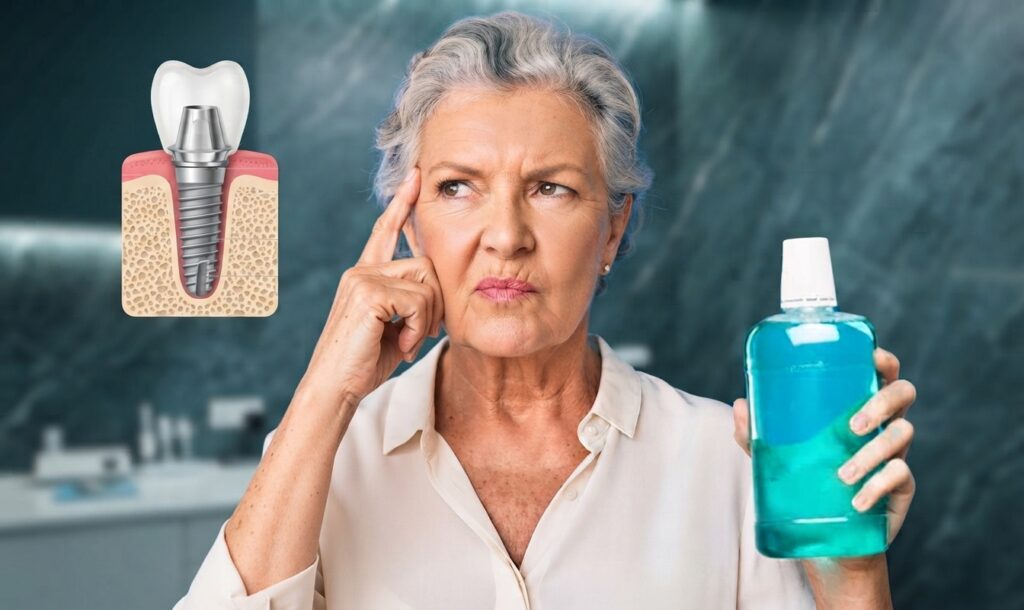
After placement day, the question of mouthwash after dental implant comes fast: should you rinse on the same evening, with which product, and for how many days without harming healing? Rinsing too early can disturb the clot, a harsh formula can burn fresh gum, and skipping antisepsis lets biofilm colonise the abutment.
The short answer from implantologists: mouthwash after dental implant starts the next morning, with a gentle alcohol-free chlorhexidine formula, for 7 to 10 days, and it never replaces brushing. For the rest of post-operative hygiene, our dental implant aftercare twelve month recovery timeline details brushing, interdental care and recalls. At Clínica Dentária Santa Catarina in Porto, every patient leaves with a written protocol, a suitable bottle and WhatsApp follow-up.
In this guide, our Porto team explains which mouthwash after dental implant to choose, exactly when to start, how long to continue, how to rinse without pressure, and which signs should make you call the clinic. You will also learn what to avoid: alcohol, tobacco, vigorous rinsing and prolonged self-medication.
Which mouthwash after dental implant to choose
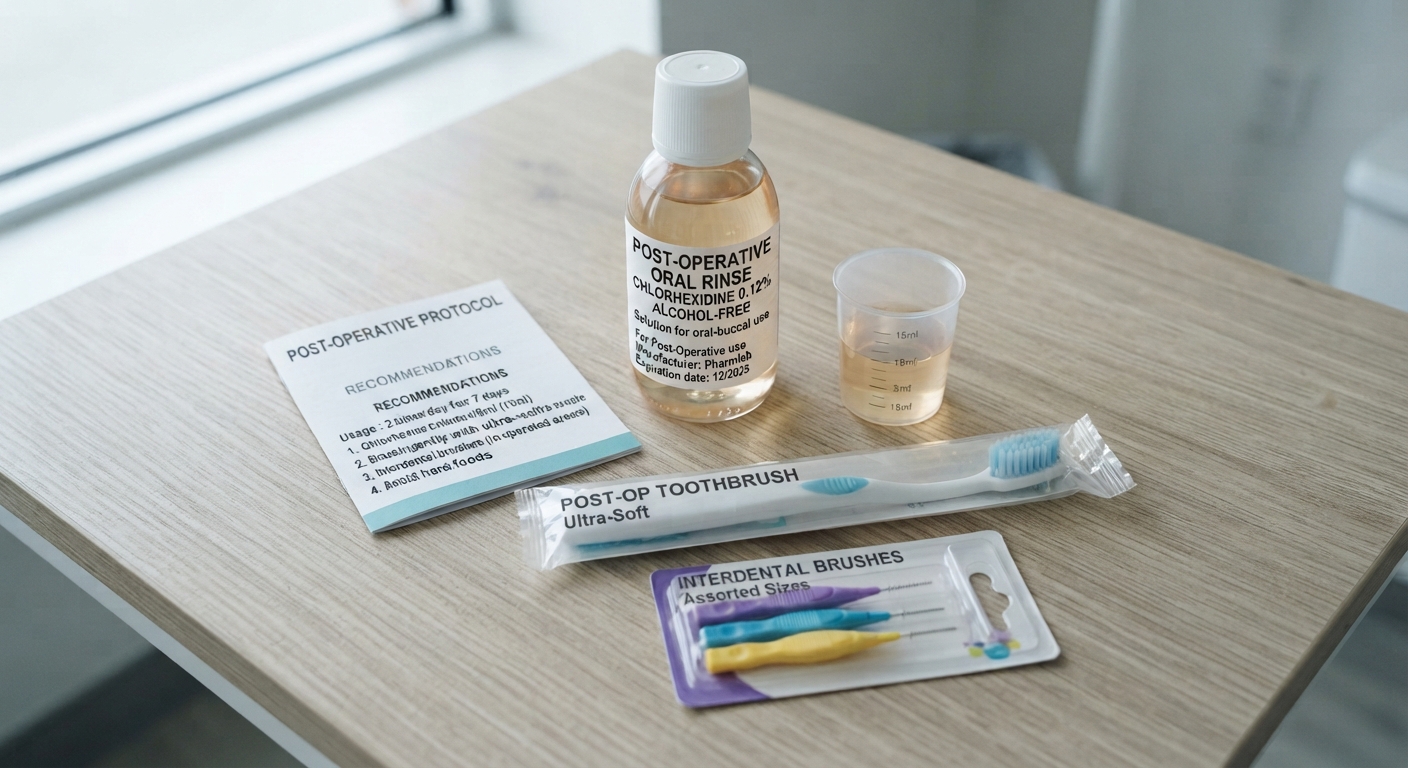
The first reflex is to reuse the bottle already sitting in the bathroom. That is a mistake after surgery: everyday rinses often contain alcohol, whitening agents or strong mint flavours that sting a fresh wound and delay tissue closure. Mouthwash after dental implant should be antiseptic, alcohol-free and prescribed for short use.
The reference molecule remains chlorhexidine gluconate, at 0.12% for routine use or 0.20% on short prescription. A 2019 systematic review of chlorhexidine rinses after periodontal or implant surgery found significantly less plaque and bleeding than with placebo, and presented chlorhexidine as a useful protective tool right after surgery, while normal hygiene is limited. The reviewers found no consensus on the best formulation, but lower concentrations such as 0.12% gave the most promising results so far. In short: useful and effective as a short post-operative course, unsuitable as a routine for months.
In practice, ask your surgeon for an alcohol-free 0.12% chlorhexidine formula that covers 10 days. Essential-oil rinses are an over-the-counter option for everyday plaque control, but they are not the usual choice on a fresh surgical wound, where stinging is more likely. Home-made warm saline does not replace the antiseptic during the first days, though it may complete the routine after week one if the clinic approves. The American Dental Association guide to mouthrinse and mouthwash separates cosmetic rinses, which only freshen breath for a short time, from therapeutic rinses with active ingredients aimed at specific conditions, and reminds patients that no rinse replaces brushing and flossing.
Chlorhexidine remains the short-course reference
Chlorhexidine lowers bacterial load around the implant neck while brushing stays delicate, and it stays active in the mouth for several hours between applications. The 0.12% dosage is generally used undiluted at 15 ml twice daily, while 0.20% is reserved for short prescriptions, sometimes at reduced volume. Always follow the label and the prescription, never stronger or more frequent.
Expect two mild and reversible effects: brownish staining of teeth and tongue after several days, and slight taste disturbance. These marks fade after the rinse is stopped and are cleaned off at the hygiene recall. A 2025 randomised trial of 60 patients compared three rinses used for 10 days after implant placement: standard chlorhexidine, chlorhexidine with an anti-discoloration system, and povidone-iodine. Healing, bacterial load and inflammation markers did not differ between groups, but patients rated the anti-discoloration formula significantly better for taste, burning and staining. The trial tested 0.20% rinses, so your surgeon’s prescription remains the reference; see the 2025 randomised trial of antiseptic rinses after implant placement.
Formulas to avoid after placement
- Alcohol-based rinses: burning, dryness, irritation of the fresh wound
- Whitening peroxide formulas: aggressive on healing tissues
- Long-term unsupervised rinsing: staining, flora imbalance, metallic taste
- Unvalidated home brews: unknown concentration and infection risk
If you doubt a bottle, photograph the label and send it on WhatsApp before use.
When to start without risking the clot
On surgery day, the blood clot forming in the operated site is the foundation of healing. Vigorous rinsing, forceful spitting or drinking through a straw can disturb it and delay healing, and in a fresh extraction socket it can even cause a dry socket: sharp pain, delayed closure, emergency visit. That is why day zero stays a rinse-free day.
Leave the area undisturbed for the first 24 hours: no rinsing and no brushing on the wound. Ice wrapped in cloth, applied 15 minutes on and 15 minutes off on the cheek during the first 48 hours, controls swelling better than any bottle.
The start comes the next morning, about 24 hours after placement, unless your surgeon instructs otherwise. This delay applies to a single implant as well as to full-arch cases, and it is not negotiable even if the mouth feels clean. An early start accelerates nothing, it only adds risk.
Day zero: no rinsing
On surgery evening, brush the teeth far from the operated area gently, without forceful rinsing. Sleep with your head slightly raised and avoid effort, tobacco and alcohol. For the broader picture of durability once integration succeeds, read how long dental implants last.
The day-one signal to start gently
On day one, start with a lukewarm rinse, head tilted, letting the liquid bathe the area without gargling and without forceful spitting: simply let it flow out over the sink. 15 ml is enough, 30 seconds is enough, twice daily is enough. Gentleness matters more than duration.
How long: duration and dosage of mouthwash after dental implant
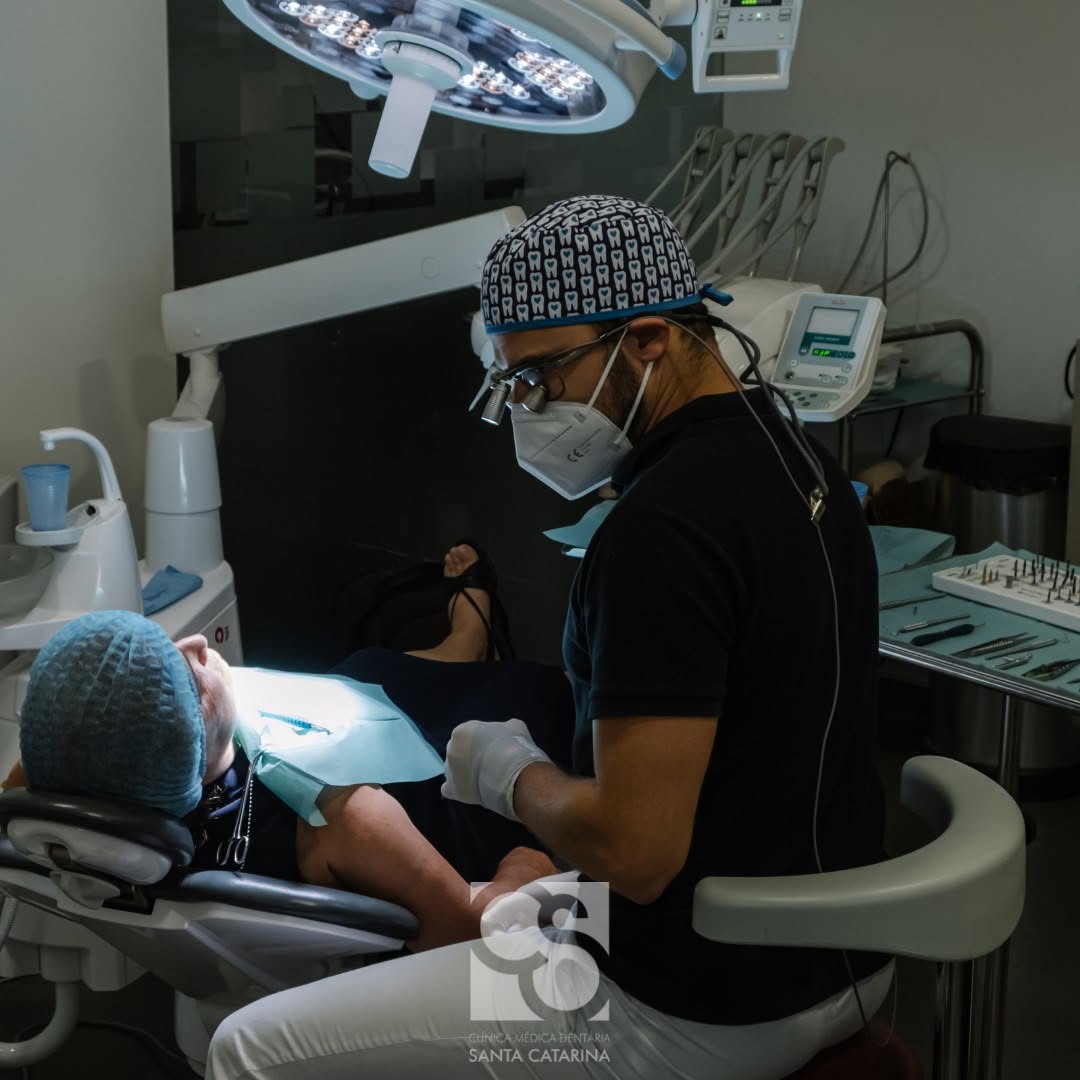
The usual duration of mouthwash after dental implant ranges from 7 to 10 days for a single placement, sometimes up to 14 days after extensive surgery or combined grafting. Beyond two continuous weeks, staining, taste changes and a pasty mouth become more likely while the extra benefit is not established. A short respected course beats an approximate month.
The standard Porto schedule: 15 ml of undiluted 0.12% chlorhexidine, 30 seconds, morning and evening, at least 30 minutes after toothpaste to avoid interaction. Do not rinse with clear water afterwards, and eat or drink nothing for 30 minutes. Chlorhexidine is a short-term tool: the 2019 review quoted above frames it as protection for the period when brushing is compromised, not as a months-long habit. Your post-operative course follows the same logic: targeted antisepsis, limited duration, then handover to mechanical hygiene.
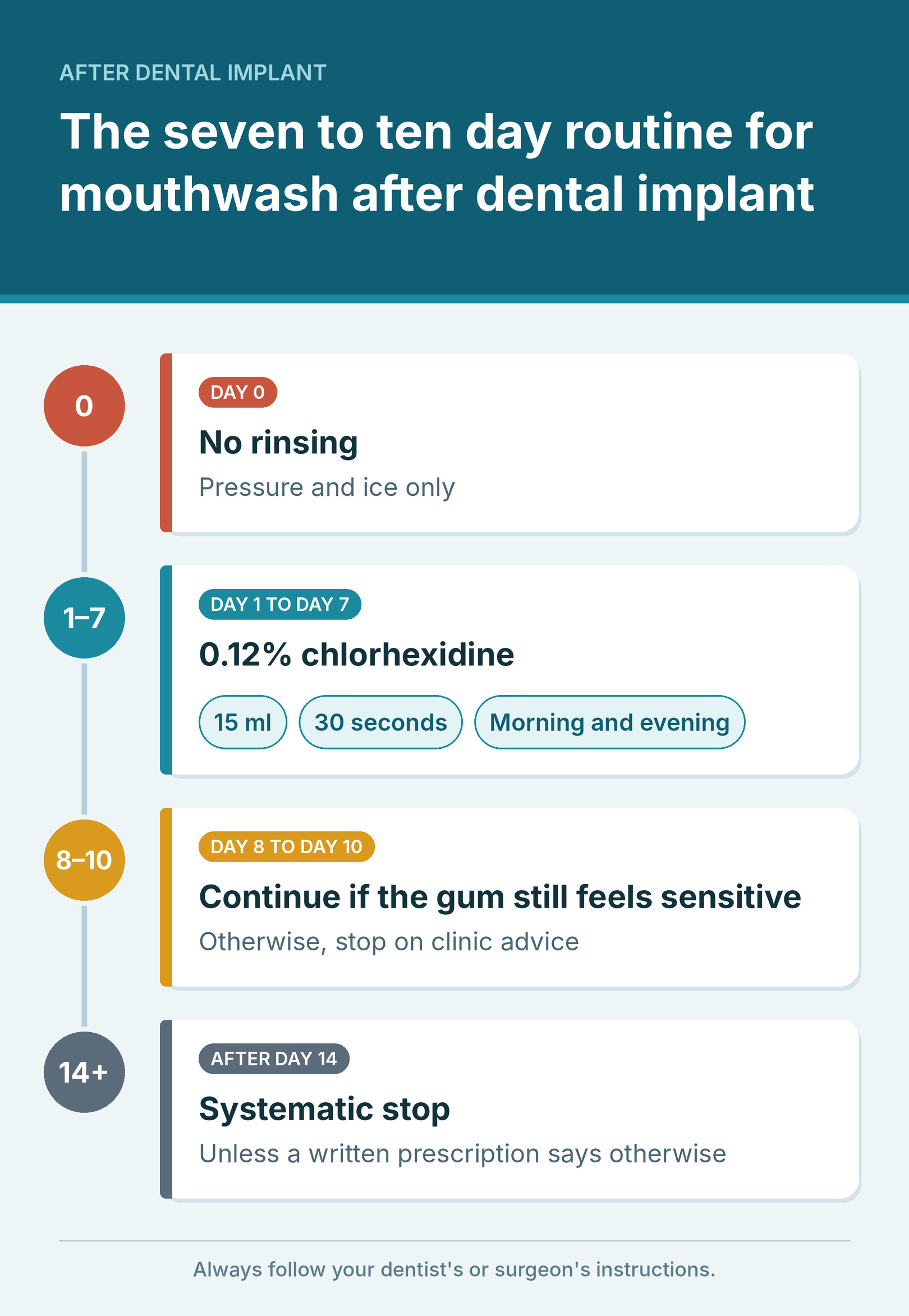
The seven to ten day routine for mouthwash after dental implant
- Day 0: no rinsing, pressure and ice only
- Day 1 to day 7: 0.12% chlorhexidine, 15 ml, 30 seconds, morning and evening
- Day 8 to day 10: continue if the gum still feels sensitive, otherwise stop on clinic advice
- After day 14: systematic stop unless a written prescription says otherwise
Photograph the area on day 3 and day 7 and send the pictures to the coordinator: stopping or extending is decided on images and symptoms, never at random.
How to rinse without pressure
Fill the dosing cap, pour 15 ml, tilt your head toward the operated side and let the liquid bathe for 30 seconds with the mouth half open. Let it flow out without forceful spitting, without a water rinse, without following with coffee. In the evening, make the rinse the last step before bed for maximum overnight protection.
| Formula | When to use it | Usual duration | Caution |
|---|---|---|---|
| Alcohol-free 0.12% chlorhexidine | From day 1 after placement | 7 to 10 days | Do not swallow, do not dilute, reversible staining |
| 0.20% chlorhexidine on prescription | Short targeted prescription | 5 to 7 days | Sometimes reduced volume, stronger taste |
| Lukewarm saline water | Complement after week one if approved | A few days | Boiled then cooled water, no excess salt |
| Everyday alcohol rinse | Never after placement | To avoid post-operatively | Guaranteed irritation of the fresh wound |
This table summarises each formula for successful mouthwash after dental implant: gentle antiseptic in a short course first, mechanical handover next, never alcohol on a fresh wound.
Complete hygiene around the rinse
The rinse replaces neither brush nor floss: it covers the period while brushing stays partial. From day 1, brush the non-operated teeth normally with a soft brush. Approach the operated area only when your surgeon allows it, usually from week 2, with gentle strokes and without pressing on stitches. Fluoride toothpaste stays allowed in small amounts, keeping 30 minutes between it and chlorhexidine.
Interdental spaces around the abutment are cleaned with calibrated brushes from the date the surgeon indicates. The oral irrigator must wait for complete healing. Poor hygiene exposes you to mucositis then peri-implantitis, the infection that directly threatens implant survival. For context on age-related eligibility and healing capacity, see our guide to dental implants for seniors over 70.
Brushing and calibrated interdental brushes
Choose a soft-bristled brush, replace it after surgery to restart with a low bacterial load, and brush two minutes twice daily. Interdental brushes should pass without forcing: if metal scrapes, take the size below. Your hygienist validates sizes at recall, never guess alone.
Tobacco, alcohol and coffee while healing
Tobacco restricts blood flow to the healing tissue and is the leading preventable cause of early implant failure: stop at least one week before surgery and throughout the healing period, as your surgeon advises. Alcohol, in drinks as in rinses, irritates and makes the wound bleed: abstain for 10 days. Very hot coffee burns thermally: lukewarm and moderate for the first three days.
Warning signs: when to call the clinic
Slight pink oozing on the first evening, swelling peaking at 48 hours then fading, moderate discomfort relieved by paracetamol: all of this stays normal. Continue the rinse unless advised otherwise, because stopping antisepsis at the first discomfort exposes you more than it relieves. Antibiotics are a separate decision made by your surgeon: our guide explains when antibiotics after a dental implant are really needed.
Some signs require a call without waiting: abundant red bleeding soaking compresses beyond 2 hours, pain worsening after day 3 instead of easing, purulent taste or foul odour, fever above 38 degrees, suture opening with abutment mobility. Photograph, note the time and temperature, and contact the coordinator at once.
Normal bleeding and swelling
Bite a clean compress for 30 minutes, head raised, ice in sequences, cold soft food: this routine settles most simple cases. Avoid effort, hot baths and flying the next day if the cheek stays very swollen without clinic advice.
Red flags never to ignore
- Throbbing pain increasing after day 3 despite painkillers
- Yellow or greenish discharge, persistent infected taste
- Fever, chills, painful lymph nodes
- Mobility of the abutment or the provisional prosthesis
With any of these signs, stop forceful rinsing, keep the gentle rinse if tolerated, and call. An infection caught on day 4 is fixed chairside, neglected to day 14 it threatens osseointegration.
FAQ on mouthwash after dental implant
Patients always ask the same practical questions about mouthwash after dental implant. Here are the answers validated by our Porto implant team, led by Dr Paulo Alexandre Carvalho, international trainer in implantology, within Clínica Dentária Santa Catarina, founded in 1968 and ISO/TC 106 certified.
Can any mouthwash be used after placement?
No. Use only an alcohol-free chlorhexidine formula prescribed for the post-operative period. High-street rinses with alcohol or whitening agents are banned while healing. If you doubt a bottle, send a photo of the label before use.
Should the mouth be rinsed on surgery evening?
No, never on the first evening. The clot must stabilise for 24 hours without rinsing or forceful spitting. Mouthwash after dental implant starts on day 1, as a gentle bath without gargling.
Is ten days enough: how long to continue?
Yes for most single placements: 7 to 10 days twice daily is enough. Extensive surgery may justify up to 14 days on prescription. Beyond that, stop and switch to brushing and interdental brushes unless your surgeon instructs otherwise in writing.
What if taste or staining bothers you?
Continue until the end unless true burning occurs: staining and taste changes are reversible. Space out only on clinic advice, never on your own initiative during week one.
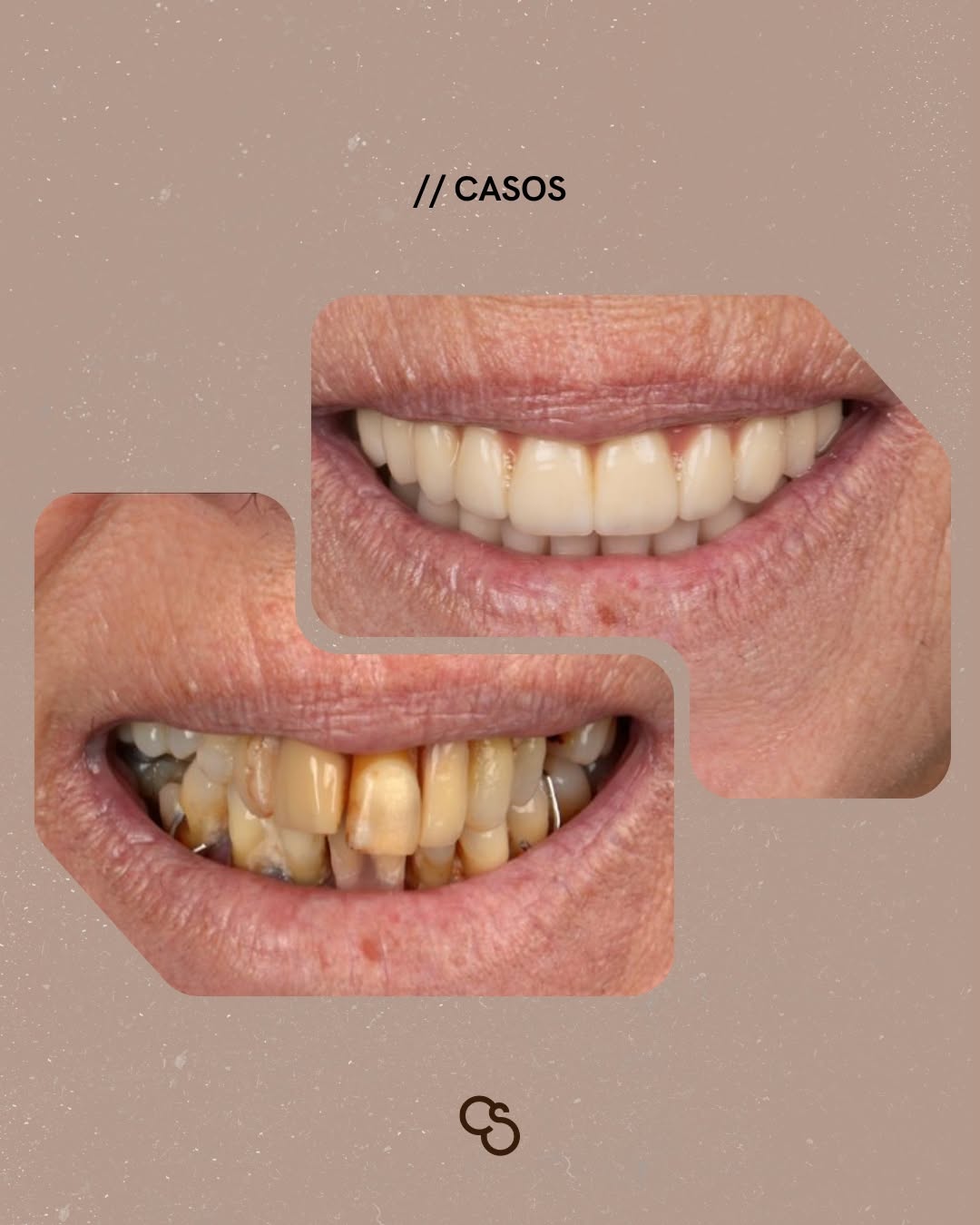
Our invitation: well-chosen mouthwash after dental implant, started on day 1 and stopped at 10 days, protects your investment and your smile. Send your panoramic X-ray on WhatsApp today: Clínica Dentária Santa Catarina replies within 24 hours with a free plan, the written hygiene protocol and a transparent quote. Ask for your free quote within 24h and travel only once the protocol is validated.
Medical disclaimer: this article informs and replaces neither clinical examination nor prescription. The choice of mouthwash after dental implant, its dosage and duration are decided with your surgeon, especially with allergy, pregnancy or ongoing treatment.