If you live with low bone density and need a fixed smile, the question of osteoporosis and dental implants comes first, before price, before travel, before brand. You want to know if an implant will hold, how long healing takes, and what your dentist must verify to keep you safe.
The short answer is reassuring: osteoporosis and dental implants can work together when bone density and medication are checked first. Recent systematic reviews find no higher implant failure in osteoporotic patients when planning is adapted. For context on age-related eligibility, see our guide to dental implants for seniors over 70, which explains how biological health matters more than birth date. At Clínica Dentária Santa Catarina in Porto, we place Straumann implants only after a full bone and medication review.
In this guide, our Porto team explains what to check first for osteoporosis and dental implants, which tests to bring, which drugs change the plan, and how we secure long-term stability without overselling. You will leave with a clear checklist to discuss with your physician and your implantologist.
How osteoporosis and dental implants interact during healing
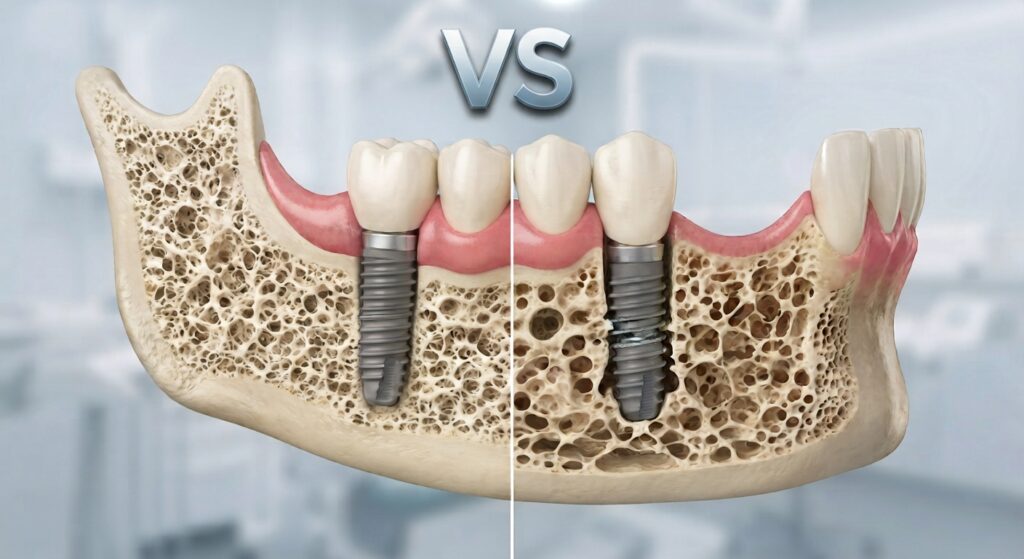
Osteoporosis reduces mineral density and weakens trabecular architecture throughout the skeleton. The jaws are vascular and remodel actively, which helps, but low density can still lower primary stability at placement. Primary stability is the mechanical grip measured in Ncm on the day of surgery, and it predicts whether immediate loading is safe.
Osseointegration is biological, not just mechanical. After placement, proteins coat the titanium surface, osteoblasts migrate, and new bone bonds directly to the implant. In osteoporotic bone this process can be slower, especially in soft posterior maxilla. That does not mean failure, it means timing must be adapted, with longer healing before the final crown when density is low.
Clinical data help set expectations. A 2025 systematic review of peri-implant disease in osteoporotic patients found peri-implantitis in about 22 percent of patients, while peri-implant mucositis was reported by only one small study (20 percent). Across the included studies, prevalence was no higher than in systemically healthy patients. The message is consistent: osteoporosis and dental implants succeed when local factors are controlled, including periodontal health, smoking, diabetes, and plaque control.
Bone quality types and what they mean for you
Surgeons describe bone from D1 dense to D4 very soft. Most osteoporotic patients present D3 or D4 in the posterior maxilla, D2 or D3 in the mandible. D4 does not forbid implants, it changes drilling, implant choice, and loading. We use under-preparation, wider tapered Straumann Roxolid implants, and hydrophilic SLActive surfaces that support early healing in softer bone.
If you wear a denture for years, resorption adds to systemic loss. A cone beam scan shows the truth in millimeters: height, width, sinus position, nerve location. Age alone never decides, imaging decides. This jaw-specific imaging is the foundation of safe osteoporosis and dental implants planning.
Why the lower jaw often performs better
The mandible is cortical and dense, even with osteoporosis, so survival there is excellent. The maxilla is more cancellous and closer to the sinus, so it needs more caution, sometimes short implants or tilted All-on-4 implants to avoid grafting. Your plan should be jaw-specific, not generic.
Bone density first: DEXA, CBCT and what your surgeon needs
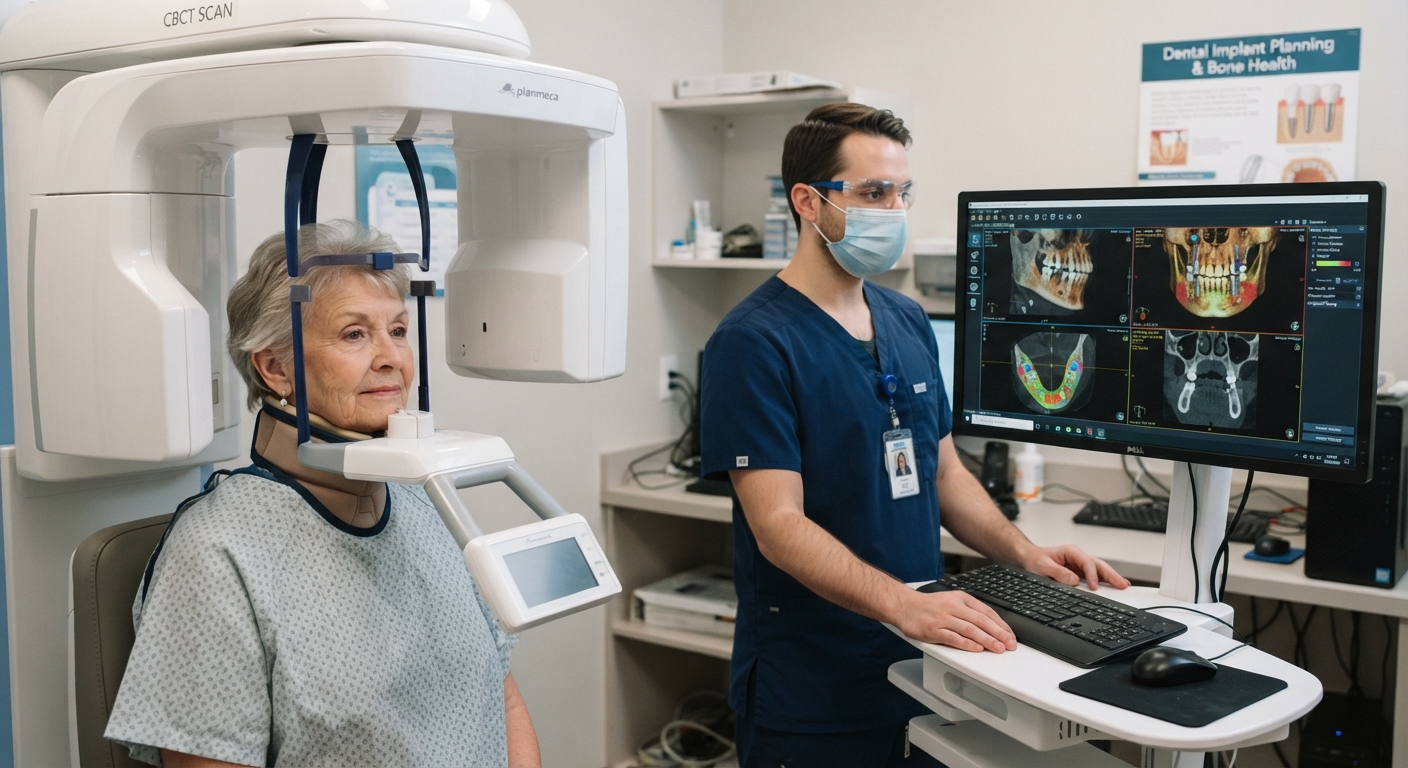
Bring two examinations if you have them: a recent DEXA with T-score and a panoramic X-ray less than twelve months old. DEXA describes systemic osteoporosis, with T-score at or below minus 2.5 defining osteoporosis and between minus 1 and minus 2.5 defining osteopenia. CBCT describes local implant bone, which is what determines feasibility.
At Santa Catarina we take a 3D CBCT in Porto when needed and measure Hounsfield units, cortical thickness, and available volume. We correlate systemic T-score with local density, but we do not refuse treatment on T-score alone. Many patients with T-scores of minus 2.8 have sufficient anterior mandibular bone for stable implants, while some with normal DEXA lack posterior maxillary height after long-term tooth loss.
Ask your physician for recent calcium, vitamin D, HbA1c, and smoking status. Vitamin D insufficiency slows mineralization, uncontrolled diabetes slows soft tissue healing, smoking raises peri-implantitis risk. Correcting these before surgery improves outcomes more than any implant brand.
Your pre-travel imaging checklist
Send via WhatsApp a panoramic X-ray, your DEXA summary, full medication list with doses and durations, and recent blood work if available. Within twenty four hours you receive a written opinion: feasible, feasible with adaptations, or graft first. If grafting is needed we say so upfront with cost and stay length.
For long-term perspective on durability once integration succeeds, read how long dental implants last, which details hygiene and follow-up factors that matter most after sixty.
When a bone graft is really needed
Grafting is not automatic with osteoporosis. We avoid large grafts by using tilted implants, short implants, or sinus lift only when height is below four millimeters. When graft is unavoidable, we prefer minimally invasive xenograft with membrane and four to six months healing. Your CBCT determines this, not assumptions.
Osteoporosis and dental implants medication check: bisphosphonates and denosumab
Medication review is as important as bone scan for osteoporosis and dental implants. Oral bisphosphonates like alendronate, intravenous zoledronate, denosumab, and glucocorticoids change healing and infection risk. Low-dose oral therapy for less than four years carries very low risk, while long-term high-dose intravenous therapy needs specialist coordination.
The main concern is medication-related osteonecrosis of the jaw, a rare but serious non-healing exposure. In patients taking antiresorptives for osteoporosis, the risk is only marginally higher than in the general population, and far lower than with oncology doses. With long-term therapy, implant placement may add a little to that risk, which is why atraumatic protocol, infection control, and careful management of extraction sockets and peri-implant infection in medicated bone matter.
Current guidance from the International ONJ Taskforce, published in 2025, suggests that antiresorptive therapy for osteoporosis does not need to be stopped routinely before implant placement. It is a weak recommendation based on very low-quality evidence, so decisions are individualized by dose, duration, and comorbidities (see the International ONJ Taskforce consensus statement on antiresorptive therapy and dental implants). According to the systematic evidence on peri-implant disease prevalence in osteoporosis rehabilitated with implants, osteoporosis was not linked to a higher prevalence of peri-implant disease or implant loss, although the number of studies is small and the authors call for longer follow-up. Never stop or pause your drug alone, any holiday is decided with your prescribing physician.
Oral versus intravenous therapy: practical differences
Oral alendronate or risedronate for under four years without steroids or diabetes: standard implant protocol, chlorhexidine, antibiotic prophylaxis if indicated, close follow-up. Longer than four years, or combined with steroids: consider drug holiday evaluation, serum CTX as adjunct only, and extended healing. Intravenous zoledronate or denosumab: physician liaison mandatory, timing surgery mid-cycle when possible, avoid extensive grafting, prefer flapless guided placement.
Denosumab rebound deserves attention. Delaying denosumab increases vertebral fracture risk, so timing is coordinated, not improvised. We schedule surgery away from injection peaks and ensure calcium and vitamin D are replete.
What to tell your implantologist exactly
- Molecule, dose, route, start date, and total duration of every bone drug
- Any tooth extraction, jaw pain, swelling, or exposed bone while on therapy
- Steroid use, diabetes, smoking, rheumatoid arthritis, and periodontal history
- Last dental cleaning, last DEXA, and vitamin D level if known
Clear medication history makes planning safe and predictable, vague history creates avoidable risk.
Are you still eligible? The safety checklist before surgery
Eligibility is medical, not administrative. We confirm four pillars: stable systemic health, acceptable medication risk, sufficient local bone or a graft-free alternative, and capacity for hygiene maintenance. If all four are favorable, we proceed. If one is borderline, we adapt. If risk is high, we postpone and explain why.
Absolute postponement is rare: recent myocardial infarction or stroke within six months, active chemotherapy, heavy intravenous bisphosphonate therapy with jaw symptoms, or uncontrolled infection. Most other situations allow treatment with adjustments, including controlled hypertension, controlled type two diabetes, and well-managed osteoporosis.
| Check before osteoporosis and dental implants surgery | What passes | Porto adaptation if borderline |
|---|---|---|
| Systemic bone status | DEXA known, vitamin D replete, no fragility fracture within 12 months | Supplementation, physician clearance, longer healing before final crown |
| Local bone volume on CBCT | Height 10 mm and width 6 mm, or graft-free tilted solution available | Short or tilted implants, All-on-4 to avoid sinus graft, staged graft if needed |
| Antiresorptive medication | Oral therapy under 4 years, no jaw symptoms, physician agreement | Drug holiday evaluation, mid-cycle timing, flapless guided surgery |
| Periodontal and smoking status | No active periodontitis, non-smoker or quit 1 week before and 8 weeks after | Full periodontal therapy first, cessation program, 3-month hygiene recalls |
| Diabetes and healing capacity | HbA1c below 7.5 percent, good plaque control | Antibiotic prophylaxis, extended soft diet, delayed loading |
Use this table as your consultation guide. Bring it to your physician and ask which row needs attention before you fly. Honest triage protects you more than optimistic promises.
Red flags that require pause
Persistent jaw pain, swelling, numbness, loosening teeth with pus, or non-healing extraction socket while on antiresorptives need evaluation before any implant. Active periodontitis must be treated first, because history of periodontitis predicts peri-implantitis more strongly than osteoporosis itself. Smoking combined with low density is the highest modifiable risk, cessation changes prognosis within weeks.
To compare full-arch options when bone is limited, see All-on-6 versus All-on-4 when you need six implants, which explains tilted solutions that often avoid grafting.
Porto protocol: safe implant planning with low bone density
Our Porto protocol for osteoporosis and dental implants is conservative and stepwise. Day one: clinical exam, 3D CBCT if not already done, intraoral scan, photographs, medical reconciliation with your physician by phone when needed. Day two: guided surgery under local anesthesia with optional conscious sedation, short sessions, low-trauma drilling with irrigation, insertion torque recorded for every implant.
We load immediately only when torque exceeds thirty five Ncm and bone quality allows. Careful sequencing avoids overload in soft bone. Otherwise we place a comfortable removable provisional and wait ten to fourteen weeks in the mandible, twelve to sixteen weeks in the maxilla for osteoporotic bone.
After surgery, you rest at your hotel with written instructions in English, chlorhexidine protocol, soft diet, and WhatsApp follow-up. Reviews on day three and day five check soft tissue closure and occlusion. You fly home after forty eight to seventy two hours with clearance, then return after four to six months for the definitive zirconia bridge if you chose a two-trip full-arch plan. Details on daily care are in our dental implant aftercare twelve month recovery timeline.
Why Straumann surfaces matter in soft bone
We place only Straumann Roxolid with SLActive hydrophilic surface, CE certified with lifetime guarantee. Laboratory and clinical data show faster early bone apposition on hydrophilic microrough surfaces, which is valuable in D3 D4 bone. Combined with under-preparation and guided positioning, this improves primary stability without overheating bone.
For background on what osteoporosis means systemically, the patient guide from the International Osteoporosis Foundation about osteoporosis explains bone loss, risk factors, and prevention in plain language. For UK readers, the NHS osteoporosis overview symptoms and treatment summarizes diagnosis and care pathways.
Cost, stay, and guarantee in Porto
Pricing is identical regardless of bone density: single Straumann implant from five hundred fifty euros, crown from four hundred euros, All-on-4 from five thousand euros per jaw, All-on-6 from six thousand three hundred fifty euros. If grafting is needed, we quote it separately before you book, typically adding one day and a defined fee. Savings reach sixty to seventy percent versus France, Belgium, or the UK, even after flights and hotel.
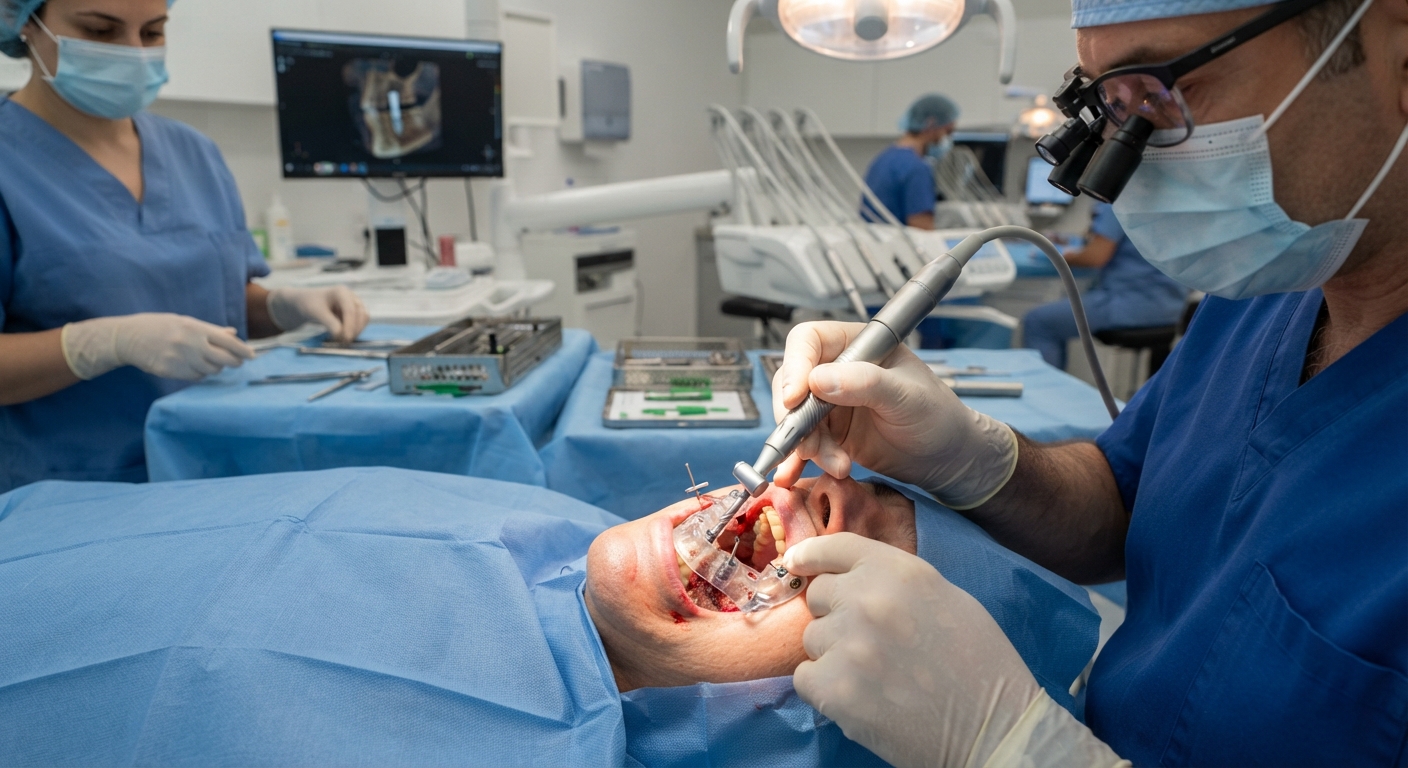
Guided surgery protocol for low-bone-density implant cases at Santa Catarina Porto.
FAQ: osteoporosis and dental implants answers
Patients ask the same focused questions about implants and low bone density. Here are evidence-based answers from our Porto implant team led by Dr Paulo Alexandre Carvalho, international trainer in implantology, with Clínica Dentária Santa Catarina founded in nineteen sixty eight and ISO TC one hundred six certified.
Can osteoporosis cause implant failure?
Osteoporosis alone rarely causes failure when planning is adapted. Systematic reviews find no higher implant loss than in patients without osteoporosis, with failures driven by infection, smoking, uncontrolled diabetes, or overload rather than T-score alone. Marginal bone loss can be slightly higher in some studies, without translating into more implant failures when maintenance is followed. Control local factors and respect healing times.
Should I stop bisphosphonates before surgery?
Do not stop alone. For osteoporosis therapy, the 2025 International ONJ Taskforce suggests continuation without routine interruption, as a weak recommendation. For long-term oral therapy beyond four years, combined steroids, or intravenous therapy, we liaise with your physician to evaluate timing or holiday. The decision balances fracture risk against jaw healing, and fracture prevention usually wins unless jaw symptoms exist.
Is bone graft safe with osteoporosis?
Small contained grafts and sinus lifts heal well in osteoporotic patients with replete vitamin D and infection control. We prefer to avoid large block grafts by using tilted or short implants. If sinus height is below four millimeters, a lateral sinus lift with xenograft remains predictable, with six months healing before loading in low-density maxilla.
How long is healing with osteoporosis and dental implants?
Expect eight to twelve weeks in the lower jaw and twelve to sixteen weeks in the upper jaw before final crown in low-density bone, versus six to ten weeks in dense bone. Provisional teeth allow normal social life during this period. Smoking extends healing and raises complications, quit one week before and eight weeks after as minimum.
Our invitation: If osteoporosis and dental implants is your concern, send a recent panoramic X-ray, DEXA summary, and medication list via WhatsApp today. Within twenty four hours Clínica Dentária Santa Catarina replies with a free plan: eligibility, options, price, stay length, and medical clearance needs. Request your free quote within 24h and travel only when safety is confirmed.
Medical disclaimer: This article is for information only and does not replace clinical examination. Eligibility for osteoporosis and dental implants is determined after CBCT, medical review, and coordination with your treating physician when antiresorptive therapy is involved.