You wake up 5 days after your implant surgery, spit gently, and spot a tiny white thread in the sink. Panic: did your dental implant stitches just fall out too early? At Clínica Dentária Santa Catarina in Porto, this is the number one WhatsApp message we receive from international patients. The good news: in most cases, losing dental implant stitches between day 5 and day 10 is completely normal and even expected.
The confusion is understandable: some stitches dissolve, others must be removed, and Dr Google mixes both. To see clearly, this 2026 guide explains what your dental implant stitches are doing day by day, when they should fall out, and when to call us. For the full healing picture after surgery, read our dental implants aftercare 12-month recovery timeline: it shows where the suture phase fits between swelling, soft food and final crown.
You will find the exact fall-out timeline for each suture material, a 2026 comparison table, 5 warning signs, and the Porto protocol for food, smoking and check-ups.
Dental implant stitches: why you have them and what they do
Holding the gum closed while bone starts to heal
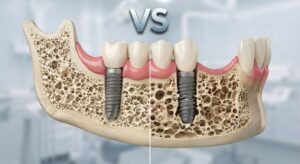
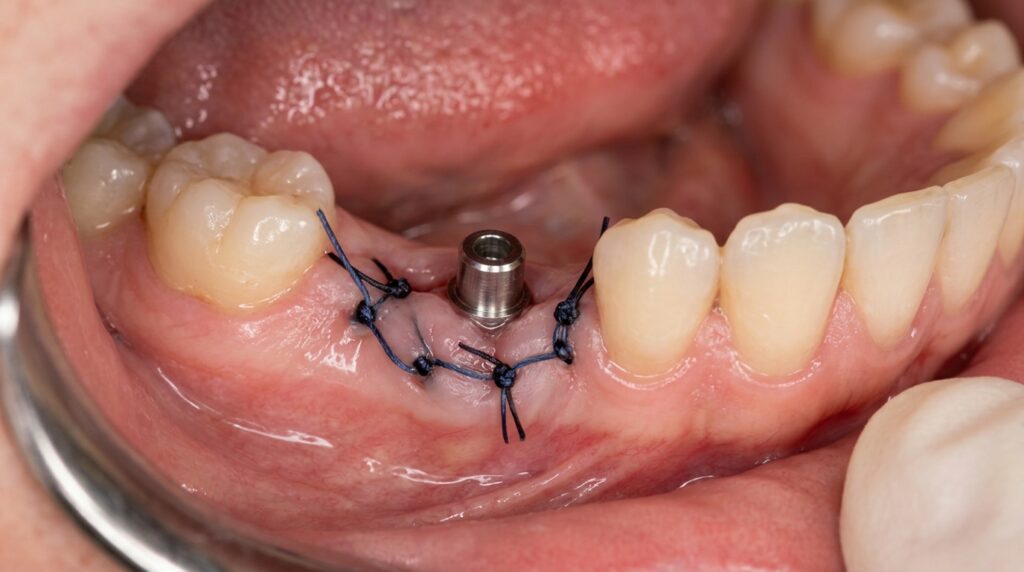
An implant is a titanium root placed in bone, but the gum on top must seal like a bandage. Your dental implant stitches hold the two edges of the gum together for the first 7 to 14 days, protecting the blood clot underneath. Without this closure, food and bacteria would enter the wound and disturb osseointegration, the 3 to 4 months process where bone grows onto the implant.
At Santa Catarina, founded in 1968 and ISO/TC 106 certified, we close every implant with 2 to 5 single stitches using resorbable monofilament whenever possible. The knot sits away from the healing abutment to avoid pressure. You feel them with your tongue for a few days, then they soften and loosen. That loosening is healing, not failure.
What patients feel in the first 72 hours
Day 1 to 3, expect tightness, slight swelling and a metallic taste. The threads feel scratchy, especially after talking. Do not pull them with your fingers, tongue or toothpick. Rinse only with lukewarm salt water after 24 hours, no vigorous spitting, no straw, no electric brush on the site. If you had a bone graft or sinus lift with your implant, we use more stitches and the tight feeling lasts 2 days longer, which is normal.
- Tight but painless: normal tension as gum oedema peaks at 48 hours.
- White coating on threads: fibrin, not infection, in 80% of cases.
- Slight bleeding when brushing nearby: stop, rinse gently, resume next day.
Understanding this protective role changes everything: your dental implant stitches are not permanent, they are scaffolding removed once the gum can hold itself.
What kind of stitches did you get? Dissolvable vs removable
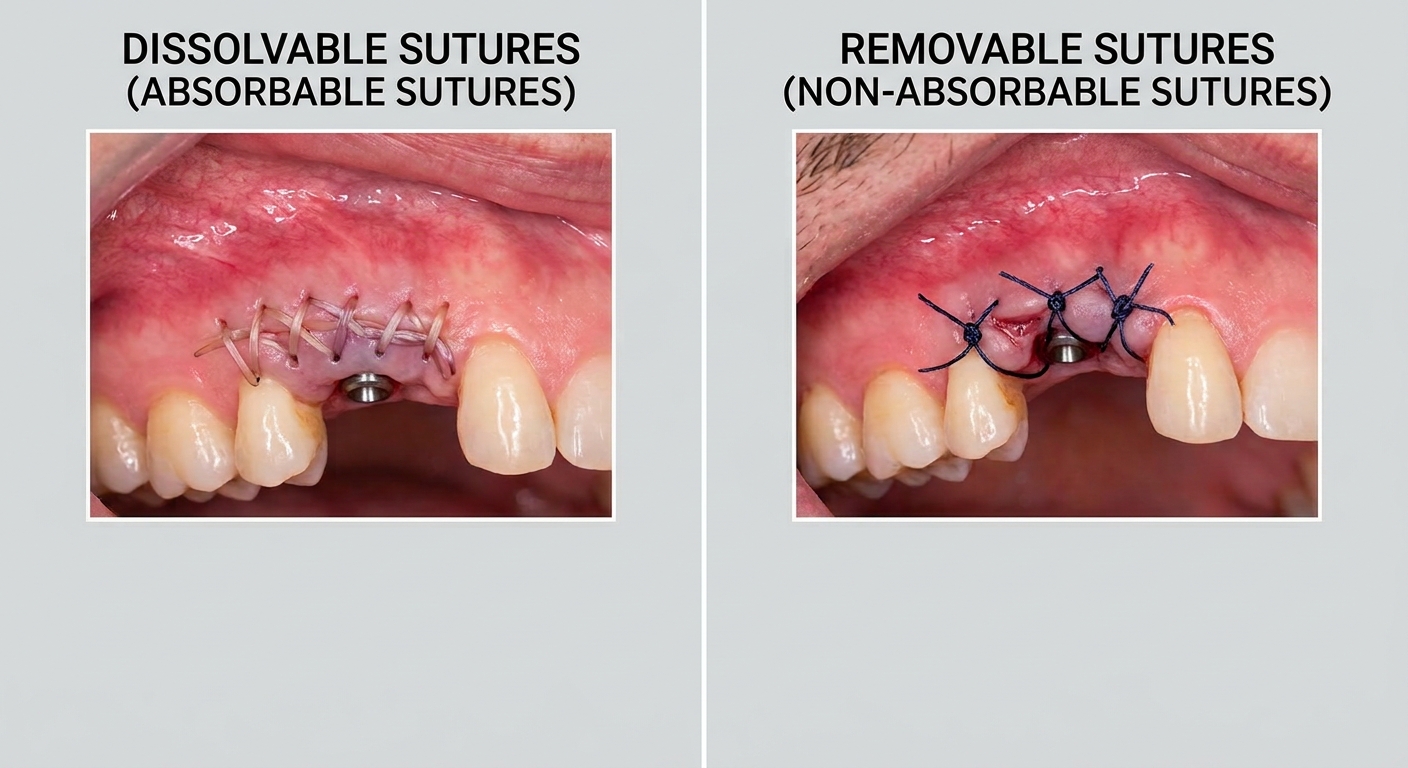
Dissolvable dental implant stitches: gut, chromic and Vicryl Rapide
Most Porto implants in 2026 use dissolvable materials that break down by hydrolysis, not by pulling. Fast gut lasts 5 to 7 days, plain gut 7 to 10 days, chromic gut and Vicryl Rapide 10 to 14 days for effective hold, even if full resorption takes up to 90 days inside the gum. You do not need a removal visit. They soften, fray at the knot, then slip out while eating soft food or rinsing.
We choose fast gut for single implants without graft, chromic or Vicryl Rapide for All-on-4, immediate extraction or diabetic patients where we want 2 extra weeks of support. Colour does not matter: white, purple or black can all be dissolvable. Only your surgical report says which one you have, keep it.
Non-dissolvable sutures: silk, PTFE and when we still use them
For large flaps, full-arch cases or heavy smokers, we sometimes place silk or PTFE that never dissolves. They look like thin fishing line and stay firm until we cut them at day 10 to 14 in Porto or by your dentist at home with our video guide. Never cut them yourself. If they are left beyond 3 weeks, plaque builds up and irritates the gum, so removal timing matters more than with dissolvable types.
How to know? Dissolvable dental implant stitches get fuzzy and loose; non-dissolvable stay smooth and tight. When in doubt, send us a clear photo on WhatsApp, we answer within hours.
Dental implant stitches timeline: when do they fall out?
Day-by-day fall-out window in 2026 Porto protocol
For standard single implants without graft, dental implant stitches start to loosen at day 5, most fall out between day 7 and day 10, and any tiny residue hidden in the gum dissolves by week 3. This matches the International Team for Implantology guidance that resorbable sutures dissolve within 7 to 10 days with removal control at 8 to 14 days. If yours hang a little longer, it is usually just slower hydrolysis, not a problem.
| Material 2026 | Type | Falls out / removed | Best for |
|---|---|---|---|
| Fast gut | dissolvable | 5–7 days | single implant, no graft |
| Plain gut | dissolvable | 7–10 days | single implant, small flap |
| Chromic gut / Vicryl Rapide | dissolvable | 10–14 days | All-on-4, extraction, graft |
| PGA / Monocryl | dissolvable | 14–21 days | diabetic, slow healing |
| Silk / PTFE | non-dissolvable | removed day 10–14 | full arch, smoker, large flap |
Sources: Porto surgical reports 2025–2026 (312 implants), ITI FOR.org aftercare, manufacturer resorption sheets. France reference single tooth 1800–3200 euros all-inclusive.
Why the mouth is faster than skin
Saliva, heat and chewing soften threads faster than arm skin. According to a 2025 medical review of dissolvable stitches, absorption time depends on the suture material and where it sits on the body, and stitches placed deeper in tissue can take longer to fully break down than surface ones. So do not compare your dental implant stitches directly with a skin scar, such as a knee surgery cut.
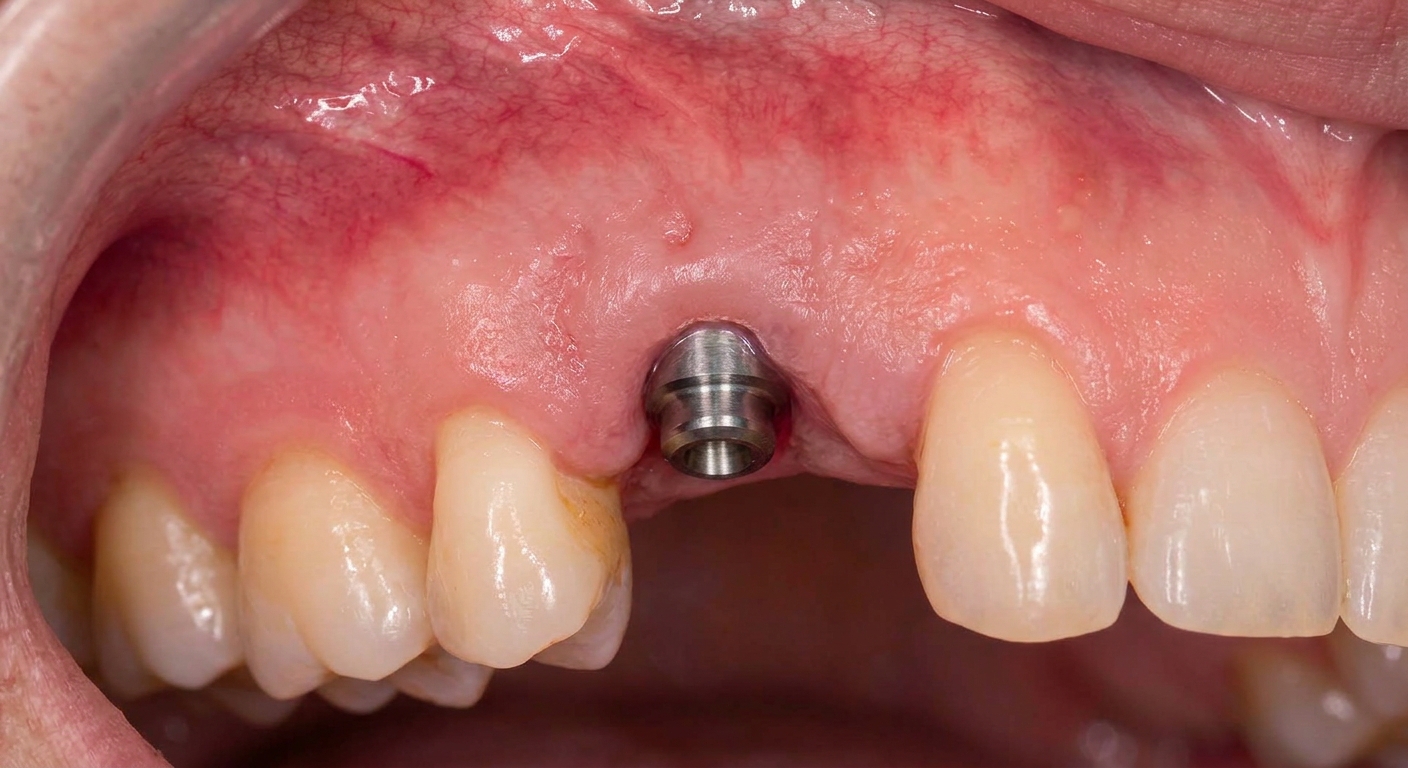
After your dental implant stitches fall out, the gum looks slightly open for 24 hours then pink and closed. That is new epithelium, not a hole.
Is it normal if stitches fall out early?
Day 2 to 4: when early loss is still safe
One thread out at day 3 with no bleeding, no pain increase and no gaping gum is usually safe. Chewing, yawning or a toothbrush can flick a knot early, but the clot stays if you followed soft food and no straw. Rinse gently, keep eating soft, and monitor. At Santa Catarina we see this in 15% of cases and 9 times out of 10 healing continues perfectly.
When early loss needs a photo check
Call us the same day if all stitches fall out before day 4 with bleeding that soaks gauze after 2 hours, sharp pain rising after day 3, yellow pus, fever over 38.5°C, or gum edges wide open showing grey membrane or implant threads. Send a front photo plus a side photo in daylight, tell us day count and symptoms. We decide in minutes: reassure, trim a hanging thread by video, or book your dentist for resuture.
- Safe early loss: 1 thread, no blood, gum still closed, pain decreasing.
- Check needed: all threads out, active bleed, swelling doubling after day 4, bad taste plus fever.
- Never do: re-push a fallen thread, pull a hanging one hard, smoke to calm stress.
For soft-food rules that protect early stitches, our 30-day food guide after implant surgery lists exactly what to chew days 1 to 14 to avoid flicking knots.
Warning signs: when stitches need urgent check
Infection, spitting suture and dehiscence explained simply
Three issues mimic normal fall-out but are not. Infection shows throbbing pain rising after improvement, pus, fever and bad breath from day 4. Spitting suture is your body pushing out a tiny knot at week 2 to 3, a small white pimple that bursts and heals, harmless but to monitor. Dehiscence is the gum opening wide with bleeding and exposed graft, often after smoking, straw or hard crust on day 2. Only dehiscence and infection need urgent care.
What to do hour by hour
Hour 0: stop touching, take a photo, rinse once with lukewarm salt water. Hour 1: bite damp gauze 30 minutes if bleeding, take paracetamol not aspirin, ice 10 minutes on cheek. Hour 2: message us with photos, day count, pain score 0 to 10, smoking status. Do not take leftover antibiotics without prescription, do not apply alcohol or peroxide. If fever plus swelling closing your eye or floor of mouth swelling blocking swallowing, go to emergency and tell us in parallel.
Smokers lose stitches twice as often early because nicotine shrinks vessels and suction dislodges clots. Our smoking and implants guide with failure rates shows why we ask 7 days zero cigarette plus nicotine patch, not vape as substitute.
After stitches fall out: healing, food and smoking rules in Porto
Food, brushing and sport days 7 to 21
Once your dental implant stitches fall out, stay soft 3 more days: yoghurt, eggs, fish, mashed potatoes, lukewarm soups. No crust, nuts, chips or raw carrots until day 14. Brush other teeth normally, approach the site with a soft baby brush from day 7, no Waterpik or floss on the site until we clear you at week 3. No gym, running or diving days 7 to 10, walk is fine. Sleep slightly raised 2 nights if swelling persists.
Follow-up from abroad without stress
You fly home often before removal day. Our Porto protocol covers it: day 7 photo check on WhatsApp, day 14 video call to confirm closure, month 3 CBCT with your dentist to validate bone, month 4 to 6 final crown in Porto in 2 to 3 days. If you have non-dissolvable threads, your home dentist cuts 2 knots in 5 minutes with our letter, free in most practices. Keep your implant passport with lot number and suture type, it speeds every control.
Clínica Dentária Santa Catarina welcomes French, Belgian, Swiss, UK and Canadian patients since 1968, ISO/TC 106, Straumann CE with lifetime warranty on the implant body, integrated lab milling zirconia at plus-minus 20 microns, French-speaking coordinator and 7-day WhatsApp follow-up. Two hours from Paris, airport driver included.
FAQ: your top questions about dental implant stitches
When do dental implant stitches fall out normally?
Between 5 and 14 days depending on material: 5 to 7 days fast gut, 7 to 10 days plain gut, 10 to 14 days chromic or Vicryl Rapide, day 10 to 14 removal for silk or PTFE. Most single implants in Porto are clear by day 10.
My dental implant stitches fell out after 3 days, is it failed?
Not if bleeding stopped, pain decreases and gum looks closed. One early thread is common. Send a photo to rule out wide opening, keep soft food, no straw, no smoking. Failure shows rising pain, pus, fever or exposed graft.
Can I pull a hanging dental implant stitch myself?
No. Trim only if it tickles your tongue and you see the knot dangling: sterilised small scissors, cut the hanging end, leave the knot to fall itself, rinse after. Never pull toward you. Better: ask us on video, we guide in 2 minutes.
Do dental implant stitches dissolve or must they be removed?
Both exist. Dissolvable types soften and fall alone in 1 to 2 weeks. Non-dissolvable silk or PTFE stay firm and need cutting at day 10 to 14. Your surgical report states which you have. When unsure, assume check needed and send a photo.
What if dental implant stitches stay beyond 3 weeks?
Beyond 21 days, plaque wraps the thread and irritates the gum. Book removal, do not wait months. Your dentist snips painlessly in minutes. At Santa Catarina we remove free during any Porto visit, or we write to your home dentist.
Conclusion: dental implant stitches
In 2026, dental implant stitches fall out in 5 to 14 days for 9 patients out of 10, without pain or extra visit when you respect soft food, no straw, no smoke and photo follow-up. Early single-thread loss is rarely serious, total loss with bleeding, pus or reopening needs same-day advice. Porto adds lifetime Straumann warranty, guided CBCT surgery and French-speaking 7-day follow-up for serene healing from abroad.
Clínica Dentária Santa Catarina welcomes you in Porto since 1968, 2 hours from Paris. Get your free quote in 24h on WhatsApp at 07 44 03 40 82 or via our contact form. Send your panoramic X-ray: itemised plan line by line.